Fabric Apps that do more than show a chart.
Photoreal 3D terrain twins, live transport maps, a flood reconstructed from open government data, and a few games to prove there is no UI ceiling. All of them run inside Microsoft Fabric, signed in with your Fabric identity, reading Lakehouse, Eventhouse or Direct Lake.
The gallery
Every card is generated from that app’s own package.json and README in the repository. Add an app, push it, and it appears here.
Digital twins and geospatial
3D, map and live-operations views of real-world systems.
Airport IQ - Live Approach
Live approach and ground operations on a photoreal 3D airport twin.
Campus Scheduler
A timetable planner's cockpit over a photoreal 3D campus twin, built entirely from open geodata — state 1 m terrain under a 20 cm orthophoto, LoD2 buildings that open into their own floors, and eight German universities in one build — with hard-constraint conflict detection, cascade what-if, and an OR-Tools CP-SAT solver proposing the smallest set of moves that repairs the week.
Flood Insights
Flood risk and gauge levels on a 3D terrain twin, with an IBCS Power BI report.
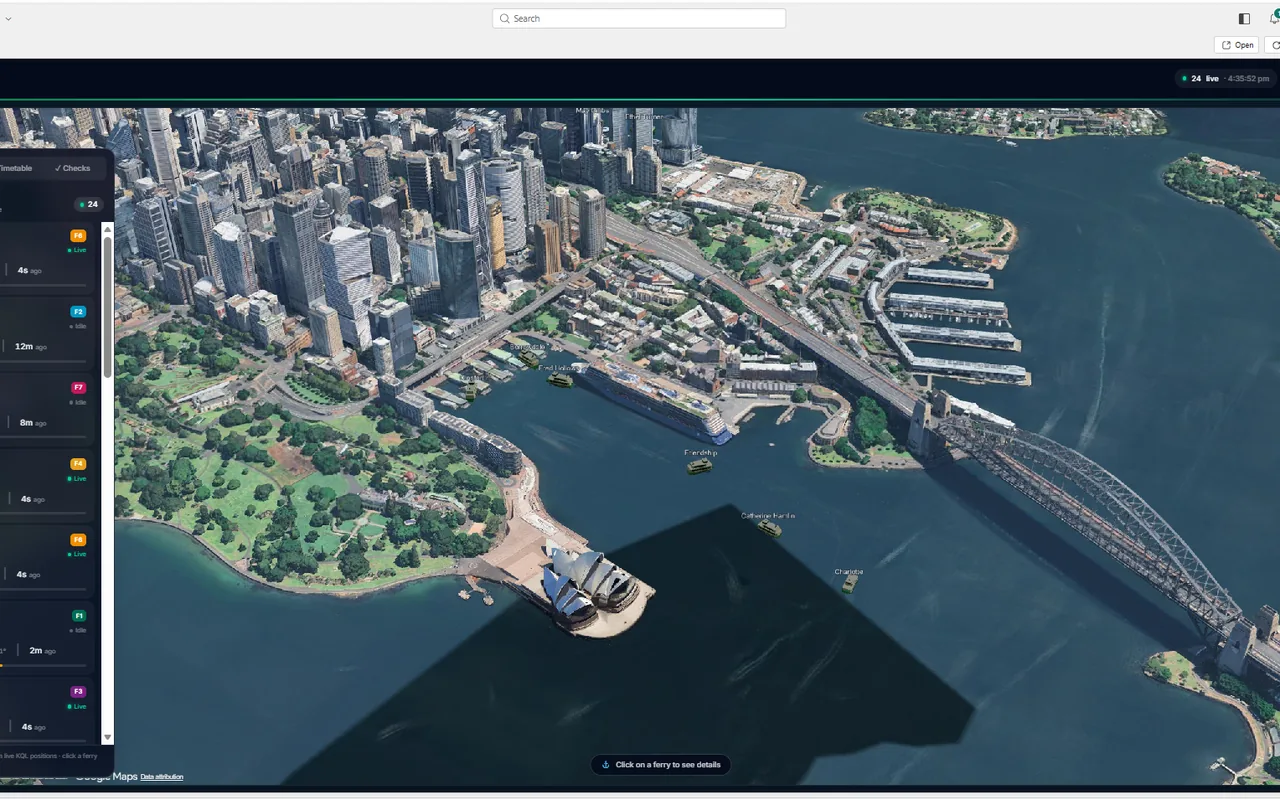
Harbour Pulse
Real-time ferry operations in Sydney Harbour on an Eventhouse-backed 3D map.
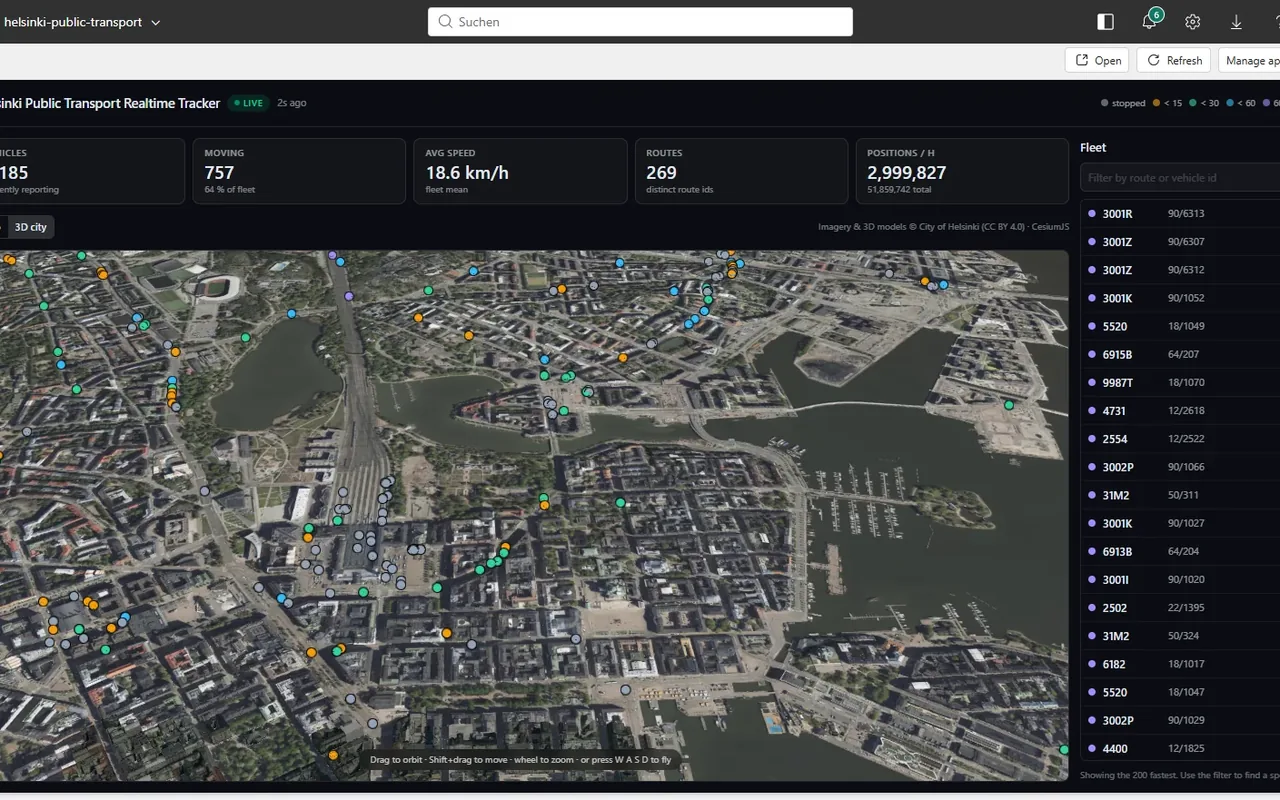
Helsinki Public Transport
Live tram and bus positions from the HSL feed, streamed through Real-Time Intelligence.
Maritime Insights
Vessel movements, port calls and cargo flows on a live maritime map.
Paragliding Insights
Photoreal 3D flight map of the Allgaeu Alps with real IGC tracks and live traffic.
Analytical apps
Apps that put data and insight in front of an end user.
Fabric and Power BI tools
Apps that inspect, document or administer the data platform itself.
Data Catalog
A browsable catalogue of every item in your Fabric tenant, with lineage and ownership.
Governance Hub
Tenant settings, capacity and access posture in one place, collected on a schedule.
Power BI Fixer
A whole Power BI toolbench in the browser: model and report explorers, BPA with one-click fixes, memory analysis, AI translations, PBIR prototyping and workspace automation.
Games and interactive learning
Canvas and game-engine apps. Proof there is no UI ceiling.
Doom
Doom running on Fabric - a WASM port with scores and telemetry in a Fabric SQL database.
Fabric Empires
A turn-based 4X strategy game whose entire game state lives in Fabric.
IBCS Trainer
Learn the IBCS notation standard by fixing charts, stage by stage.
Jump and Run
A canvas platformer with levels and high scores served from Fabric.
Run one in your own tenant
Nothing here is a hosted demo you can only look at. Each app carries its own README with the full deploy path, and every one of them builds and runs locally first.
git clone https://github.com/KornAlexander/Fabric-Apps.git
cd Fabric-Apps/industry/helsinki-public-transport
npm install
npm run dev
The geospatial apps rebuild their own terrain from open data rather than shipping it, so a clone stays small. Each of those has a documented pipeline, usually one command.
How they are built
Three things are true of every app in this repository.
Your identity, not a secret
Apps sign in with the Fabric identity of the person using them. No service principal, no shared key in a config file. Where an app queries Kusto, it does so as the signed-in user, so row-level security actually means something.
Open data, properly attributed
Terrain, buildings, orthophotos, vehicle feeds and weather records all come from open government sources. Each app reproduces the attribution its licence prescribes, verbatim, and streams from the publisher rather than redistributing a copy.
Checked before it ships
The repository gates itself: no tenant identifiers, no customer names, no broken links, a media budget, and a rule that a post about an app must name that app’s original author. The site you are reading is generated from the same source.