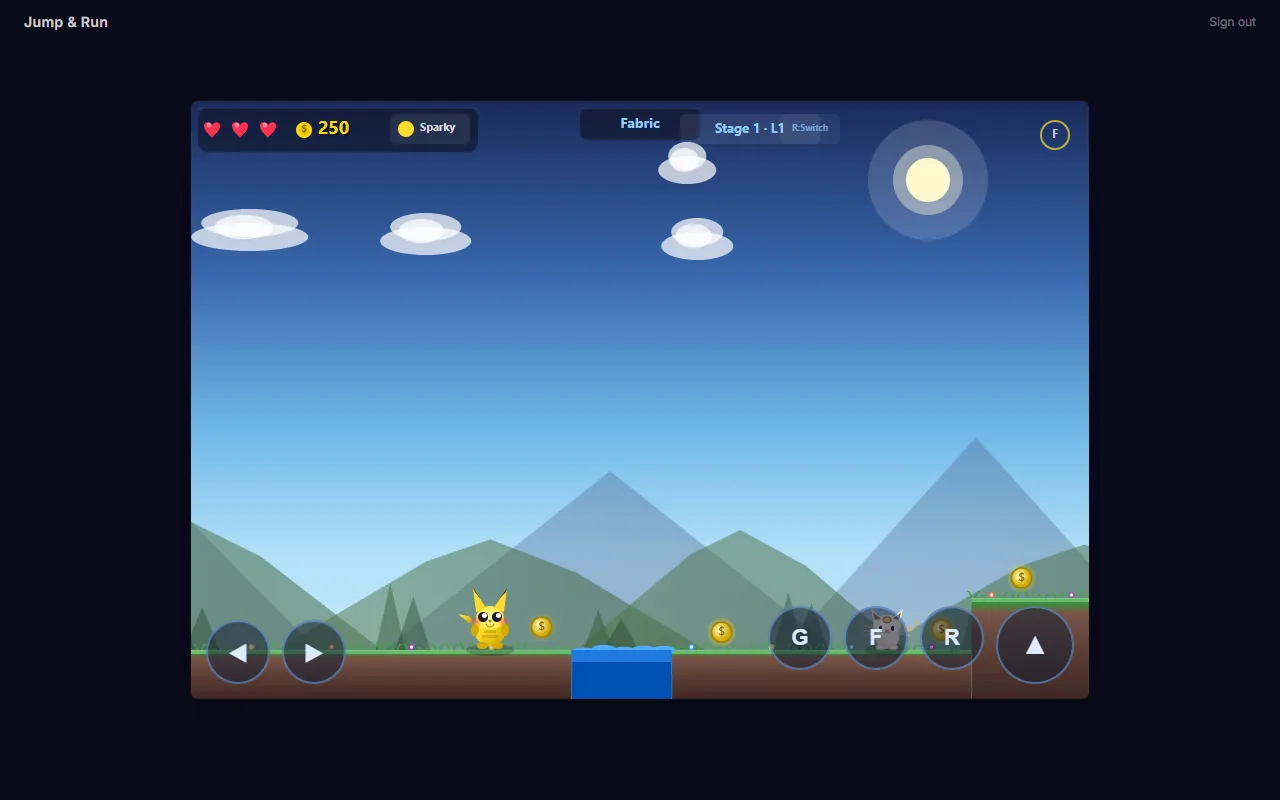
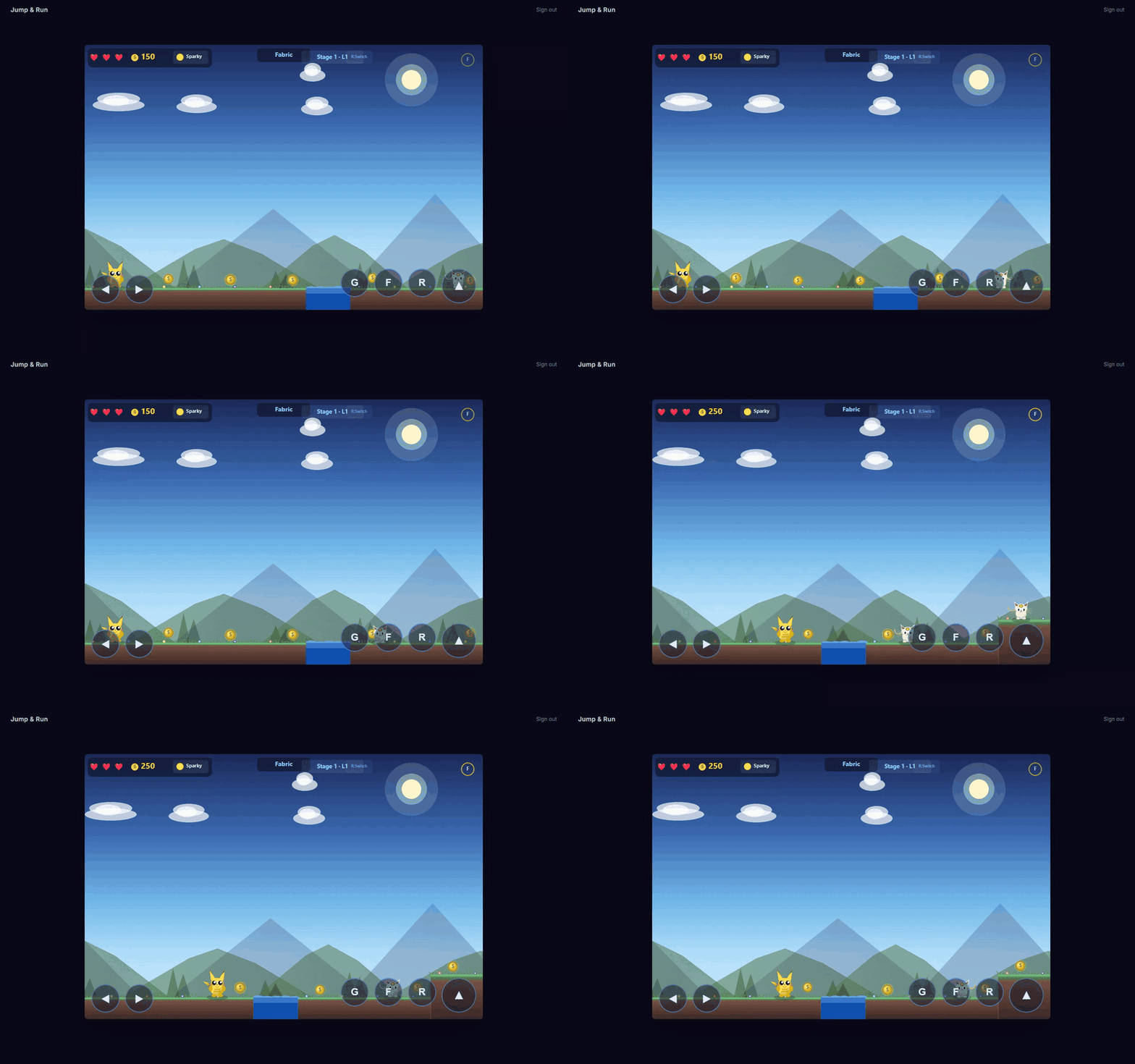
The single-file HTML5 Canvas platformer
(jump_and_run_v2.html) embedded in a
Fabric-authenticated Rayfin app. It runs in an <iframe> and reports each
finished play-through to the host, which persists it to a typed GameStats
entity through the Rayfin data client.
What it does
- Ten themed stages, 100 levels, built from layout archetypes
- Stage select with progress saved per player
- Responsive canvas with on-screen controls, so it works on a phone
- Every finished run is written to a typed entity through the Rayfin data client
Gameplay features
- 10 main stages, 100 levels. Levels are grouped into ten themed main
stages (Meadows, Forest, Desert, Skies, Swamp, Caverns, Volcano, Glacier,
Ocean and the Twilight Expanse), ten levels each. The flat
LEVELStable is generated from aSTAGESmodel (see thebuildLevelsfunction), so difficulty ramps smoothly across and within stages instead of scaling one template. - Varied layouts. Each level is built from one of several layout archetypes
(
stairs,pits,islands,tower,gauntlet,river), cycled within each stage so the levels differ in structure. - Stage select with saved progress. After entering your name you choose a
stage to start from. Stage 1 is always available; clearing a stage's last
level unlocks the next one. Unlocked stages are persisted per-browser in
localStorage, so progress survives reloads. (Tying progress to the signed-in account via the Rayfin data model is a possible follow-up.) - Mobile / landscape support. The canvas scales responsively, on-screen touch buttons appear automatically on touch devices, and a "rotate to landscape" overlay is shown in portrait. Keyboard controls still work on desktop. Stages are picked by tapping/clicking a cell, or with the arrow keys / number keys plus Enter.
- Cheat codes. Type
lebenduring play to toggle infinite lives (German Leben = lives). PressLthen a number to jump to that level (L9→ level 9,L12→ level 12).
Getting started
npm install
npm run dev
Open http://localhost:5173, sign in, and play. When a run ends (win or game over), the game posts its stats to the React host and the header shows "Run saved".
This app is fully self-contained — it depends only on the published
@microsoft/rayfin-*packages (v1.33.x) from the public npm registry, so it installs and runs on its own without theproject-rayfinmonorepo.
How the migration works
| Original (Fabric notebook) | This app |
|---|---|
Game played via displayHTML() in a notebook cell |
Game served from public/game/ and rendered in an <iframe> |
| Game-over JSON hand-pasted into a Save cell | stats.publish() posts the JSON via window.parent.postMessage |
JSON appended to a game_stats Delta table |
GamePage calls client.data.GameStats.create(...) |
The stats.publish() bridge postMessages the payload to the parent window so
the host can persist it. The game also adds 10 themed stages (100 levels) with
varied layouts, a stage-select screen with saved progress, mobile/touch
controls, and cheat codes (see Gameplay features).
Project structure
├── public/game/jump_and_run_v2.html  # The game (Canvas platformer + stats bridge)
├── rayfin/
│   ├── rayfin.yml                    # Fabric service config (auth + data + hosting)
│   └── data/
│       ├── GameStats.ts              # One row per play-through
│       └── schema.ts                 # Registers GameStats
├── src/
│   ├── main.tsx                      # Entry point + Rayfin client bootstrap
│   ├── App.tsx                       # Routes and auth gate
│   ├── pages/GamePage.tsx            # Embeds the game + saves stats
│   ├── hooks/AuthContext.tsx         # Auth context
│   ├── components/AuthPage.tsx       # Sign-in UI
│   └── services/                     # Auth + typed Rayfin client wiring
└── package.json
The data model
GameStats (rayfin/data/GameStats.ts) mirrors the game's stats.toJSON()
payload (score, deaths by cause, coins, jumps, attacks, forms collected, final
form, level reached, duration). Each record is scoped to the signed-in player
via user_id (from the JWT sub claim), so a player only sees their own runs.
Scripts
| Command | Description |
|---|---|
npm run dev |
Deploy app to Fabric and start local dev server |
npm run build |
Production build |
npm run build:fabric |
Build for Fabric deployment |
npm run lint |
Lint with ESLint |
npm run test |
Run unit tests with Vitest |
npm run rayfin:up |
Deploy app to Fabric (no local dev server) |
Fabric architecture
npx rayfin up provisions:
- Entra sign-in (Fabric identity)
- Fabric SQL database
- Static web app
Credits
Part of Fabric-Apps, MIT licensed.
Data
Generated level data. No external source.