A turn-based 4X strategy game whose tech tree is a certification syllabus.
▶ Play it in your browser
No install and no sign-in. It runs on a phone too.
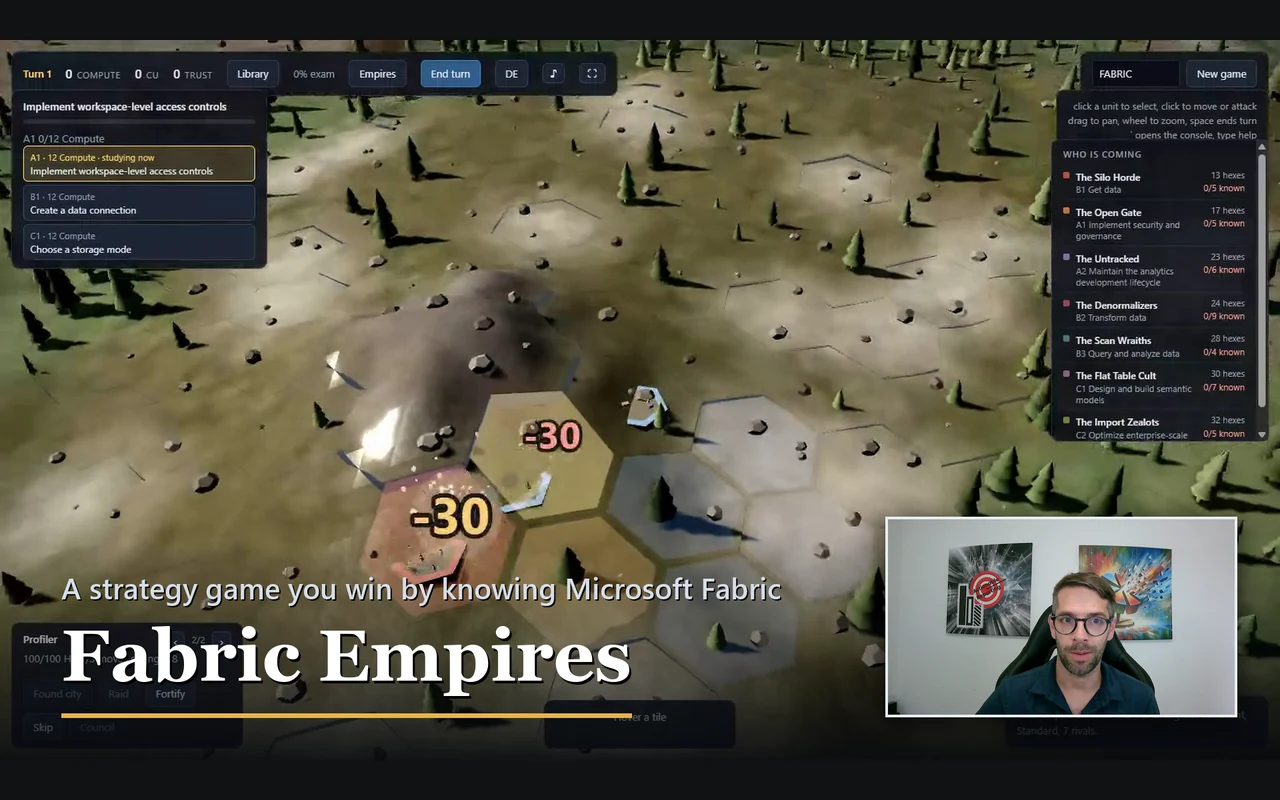
You explore a procedurally generated hex map, found cities, work tiles for four resources, research a technology tree and fight rivals over it. That is the 4X genre: explore, expand, exploit, exterminate, a form that has existed since the early 1990s and that dozens of commercial and open-source games share.
The one thing this does differently: the technology tree is the published skills outline of a real exam, and researching a node means answering a real question about it. Get it right and your army is stronger this turn. Get it wrong and you lose the battle, and the game tells you what you did not know.
This is a personal project. It is not a Microsoft product, and it is not affiliated with, endorsed by, or sponsored by Microsoft.
Every question is original. They are written from the publicly published skills-measured outline and public documentation. No exam content is reproduced, and none is derived from having sat the exam.
What it does
- Turn-based 4X strategy: cities, armies, tech trees and sieges
- The entire game state lives in Fabric - every turn is a transaction
- Map, factions and save games are rows, not files
What kind of game is this
A conventional 4X, built out of the genre's ordinary vocabulary:
| Map | Procedurally generated hex tiles, from a seed you type |
| Cities | Founded by a settler unit, work the tiles inside their border, grow on a food-equivalent resource |
| Economy | Four resources: one local and three pooled into a treasury |
| Research | A prerequisite graph of nodes, unlocking units |
| Units | Twelve types across settler, worker, scout, melee, ranged, siege, defensive, transport and support roles |
| Combat | Strength against hit points, with terrain and fortification modifiers |
| Fog of war | Explored and visible tracked separately |
| Rivals | Seven opposing factions with their own settlements |
| Victory | Military, technological, or by sitting the exam |
None of that is unusual, and none of it is meant to be. The genre furniture is deliberately conventional so that the one unusual idea is the only thing you have to learn. Somebody who has played any 4X can start here without reading instructions, which is the entire point: the novelty budget is spent on the questions, not on reinventing how a settler works.
If you want the world explained properly, including why each rule is the way it is, read STORY.md.
What makes it a study tool rather than a game with a quiz in it
Four design decisions, each recorded with its reasoning in PLAN.md:
- A city cannot reach its highest rank on population alone. It needs topics you have retained, graded by a spaced-repetition model. A settlement grown purely on food stalls.
- Research and soldiers come out of the same resource, so every unit built is a topic not learned.
- Reviews are a bonus, never a punishment. Nothing accrues while you are away, and no city can ever be lost to neglected revision.
- Your enemies are misconceptions, not companies. Each quizzes you on a different branch of the outline, so the direction a war is coming from tells you what to revise.
Running it
npm install
npm run verify      # types, content checks, and the test suite
npm run build
npm run serve:standalone
That is the whole game, hosted from static files. There is a second edition that adds an AI study coach and question drafting; it is the same bundle with a host that holds an API credential, and it is described in section 38 of the plan.
Bring your own subject
The exam outline is supplied to the engine as an opaque graph. The engine never learns what a topic means, so any syllabus works: download the sample spreadsheet in the setup screen, replace the rows, and the game builds a tech tree out of your questions instead.
What is in here
| STORY.md | The world, and why every rule is the way it is |
| PLAN.md | The full design log, decision by decision |
| NOTICE.md | What ships, what deliberately does not, and why |
| MUSIC-LICENSING.md | The licence position on the generated music |
The repository is source only. The terrain, water, sky and every object on the map are generated at runtime from the world seed, so a clone is a few megabytes rather than a few hundred. The music is the one exception and is not included; the game runs silently without it and nothing breaks.
Licence
The source is MIT. See LICENSE.
The audio and video are not in this repository and are not covered by that licence: see NOTICE.md and MUSIC-LICENSING.md.
"Microsoft Fabric" and "DP-600" are Microsoft names, used here descriptively to say what the study material is about. No Microsoft logo, product logo or certification badge appears anywhere in this project.
Fabric architecture
npx rayfin up provisions:
- Entra sign-in (Fabric identity)
- Static web app
Getting started
npm install
npm run dev
npx rayfin up --workspace-id <your-workspace-guid> --tenant <your-tenant-guid>
Any workspace or item id this app needs is read from the environment, with no default.
Project structure
app/            the application shell
engine/         game / simulation engine
learn/          learning content
rayfin/         deployment config - redirect URIs are loopback only
tools/          data pipeline and build helpers
Scripts
| Script | What it does |
|---|---|
npm run build |
production build |
npm run content:build |
|
npm run content:check |
|
npm run deploy |
|
npm run dev |
dev server on http://localhost:5173 |
npm run lint |
lint |
npm run publishable |
|
npm run record:intro |
|
npm run serve:capacity |
|
npm run serve:standalone |
|
npm run smoke |
|
npm run test |
unit tests |
npm run test:watch |
|
npm run typecheck |
|
npm run verify |
Data
Sources and their licences are listed in NOTICE.md.
Credits
Third-party data and licences: NOTICE.md. Licence: LICENSE. Copyright (c) 2026 Alexander Korn.