Who may create what, where — and why.
A self-hosted governance accelerator for Microsoft 365, Fabric and Power Platform. It answers one question no single Microsoft admin surface can answer today:
Who, right now, can create a Copilot Studio agent / a Power App / a Fabric App / a Fabric data agent / a Power BI report — and who said they could?
Built as a Fabric App (Rayfin). Deployed into your tenant. Your data never leaves it.
Status: Phases 1–11 of 17. The module contract, setup pre-flight, bootstrap, T0 degraded mode with a live Inventory, the four server-side collectors, the Governance Model read path with module-owned pages, the entitlement model with a Personas & Recipes editor, the Can-Do Explorer, the drift engine, the
POL-001…027policy pack, the Entitlements store and the Default-environment posture score, the server-side write-gate framework with an audit trail, Requests → Approvals → verification, the licence-free Power Platform actuator set, and the manual task queue are implemented and tested. Seven binding kinds can be written: Entra group membership, Fabric workspace role, and the five Power Platform ones. The five with no write API become guided tasks instead. See PLAN.md §17 for the full roadmap.Everything is verified offline: the logic is unit-tested against fixtures and the collectors are inlined into the notebooks verbatim. Nothing has executed against a real tenant yet — that needs the admin prerequisites below.
What it does
- Tenant settings and their propagation delay, collected on a schedule
- Capacity and workspace posture in one view
- Power Platform environments alongside Fabric, because nobody asks about only one
- Collector notebooks that hold no secrets - everything resolves at run time
Why this exists
Creation rights for those artifacts live in four different control planes with incompatible granularity — and several of them have no preventive control at all:
| Fact | |
|---|---|
| 🔴 | Copilot Studio agent creation cannot be disabled. Microsoft's documented mitigation is to block usage via data policies. |
| 🔴 | Fabric has no per-item-type workspace role. A Contributor can create every item type not separately gated by a tenant setting. |
| 🟡 | Org App audience membership has no public write API. Portal only. |
| 🟡 | M365 Copilot agent controls are admin-center only. No documented API. |
| ⚠️ | Fabric tenant settings are explicitly "not a security measure" — Microsoft's own words. |
So this tool does not pretend to be a universal enforcement engine. It is an entitlement system of record that compiles a human-readable model — "Alex is a Report Author in Finance" — into the concrete bindings each plane understands, writes them where an API exists, raises a guided task where it does not, and then continuously verifies that reality still matches the model.
Every capability in the UI carries its honest control mode:
| Badge | Meaning |
|---|---|
| 🟢 Preventive-automated | The app writes the control. Creation is actually gated. |
| 🟡 Preventive-manual | The control exists, but portal-only → guided task + machine verification. |
| 🔴 Detective only | No preventive control exists → inventory, alert, clean-up. |
Being honest about this split is the product.
The four modules
Switchable independently, in-app, live. The app must be useful with any subset — including exactly one.
| Module | Covers | Needs |
|---|---|---|
| M-FABRIC | Tenant settings, capacity overrides, workspaces + roles, items by type, org apps + audiences | Fabric capacity; Fabric Admin for tenant-wide read |
| M-PP | Environments, Dataverse security roles + table privileges, data policies, environment-creation settings, maker inventory | An unlicensed Dataverse application user |
| M-AGENT | Agent 365 registry, Entra Agent ID, blueprints + sponsors, Copilot Studio bot privileges |
Agent 365 licence (degrades gracefully without it) |
| M-ENTRA | Security groups, transitive membership, group-based licensing | Graph read |
Entra is everyone's substrate. Security groups are the one currency all four planes accept, so the per-user write path is usually a single Graph call — not forty admin APIs.
Licence position
The Governance Hub itself needs no Power Apps, Power Automate or Copilot Studio licence, and its Power Platform controls work without Managed Environments. Verified against Microsoft Learn:
- Dataverse application users are unlicensed by design — "you can create an unlicensed application user"; a service-principal app user "can't have a user license associated with it".
- Admins administer without a licence — Global and Power Platform admins explicitly do not need one.
- Application users bypass environment security groups, so one app user reaches every environment without joining anything.
- DLP has no licence prerequisite and is absent from the licensing FAQ's "security and governance licensing requirements" list.
- Managed Environments licensing is tied to active usage, not membership.
What you genuinely lose without Managed Environments: default-environment routing, environment groups, proactive sharing limits, solution-checker enforcement, usage insights, IP firewall, and Power Platform pipelines. The app reports exactly which of these you are missing rather than arguing about it. Details in PLAN.md §8.5.
⚠️ The Default environment is the one real hole. A security group cannot be bound to it, and
Basic User+Environment Makerauto-assignment there survives the opt-out. There is no supported way to remove Environment Maker in Default. The app ships a dedicated posture view for the six licence-free hardening levers instead of pretending otherwise (§8.6).
Reach tiers — start with no admin consent
The default first-run experience needs no admin consent at all. A tool that shows something useful in the first five minutes is the one that gets a pilot.
| Tier | Identity | Reach | Unlocks |
|---|---|---|---|
| T0 — Explore (default) | your own token | only what you can already see | Setup, Inventory, partial Can-Do Explorer |
| T1 — Observe | + SP-READ with tenant-wide read |
whole tenant, read-only | Drift, Policies, Simulation, Evidence export |
| T2 — Act | + SP-FABRIC / SP-GRAPH / SP-PP |
writes, behind four gates | Requests → Approvals → automatic grant |
Every screen renders at T0 with an honest "this view is limited" banner — never an error.
Safety model
This tool can, in later phases, grant workspace roles and Entra group membership. That makes it a privilege-escalation primitive if built carelessly. So:
Four write gates, all evaluated server-side in the actuator notebook — the browser's opinion is never trusted:
- Master kill switch — ships
false. - Per binding kind — ships with nothing armed.
- Per scope allow-list — ships empty. A pilot runs against three workspaces, not a tenant.
- Prior successful dry run for that kind × scope within 30 days — so "we tested it" is a machine fact, not a claim.
Plus unconditional invariants no configuration can override:
Admin,System Administrator,Owner,Global Administratorare never granted.- Unjustified access (
Extradrift) is never auto-removed — that is how a governance tool takes production down at 03:00. Removal is always an explicit human decision. - Every attempt writes an audit row, including refusals, with before/after JSON.
- Service principals cannot modify their own entitlements.
- No secrets in the SPA. The bundle is served anonymously; all secrets live in your Key Vault and are read only inside notebooks.
- No telemetry.
telemetry.enabledexists as a config key purely so that "we send nothing" is auditable rather than asserted.
A permanent header chip shows WRITES: OFF or ARMED: n kinds · m scopes. Nobody should
ever have to guess whether this tool is live.
What Phases 1–2 deliver
src/
  modules/            ← the module contract: types, registry, four plane modules
    types.ts            GovernanceModule, ModuleAvailability, InventoryResult, BindingKindDef
    index.ts            registry: compile-time flags, probes, collectors, tier maths
    fabric/ pp/ agent/ entra/
  domain/
    writeGates.ts     ← the four gates + invariants (pure, 20 tests)
    preflight.ts      ← pre-flight derivation (pure, 9 tests)
    inventoryView.ts  ← gap reporting, filtering, counting (pure)
    govSchema.ts      ← the table/column allow-list every DAX query is validated against
    dax.ts            ← injection-proof query construction (pure)
    capabilities.ts   ← what each creation right *is*, and how it compiles into a plane
    personas.ts       ← the shipped persona seed + override merge + the compiler
    effective.ts      ← the Can-Do engine: collected facts → who can do what, and why
  i18n/               ← EN/DE, key-parity enforced by test
  services/
    govConfig.ts      ← gov_config key/value store, conservative defaults
    udfClient.ts      ← fabric_proxy + Graph read hops
  hooks/
    GovernanceContext.tsx  ← config, live availability and inventory, one source of truth
  components/
    TierBadge.tsx · PartialViewBanner.tsx · WriteChip.tsx · CheckRow.tsx · StatusPill.tsx
  pages/
    SetupPage.tsx     ← live pre-flight, module status, bootstrap trigger
    InventoryPage.tsx ← live T0/T1 inventory with per-plane gap reporting
    SettingsPage.tsx  ← module toggles (the demo lever) + write-gate view
    DashboardPage.tsx ← honest placeholder
bootstrap/
  gov_bootstrap.py       ← idempotent provisioning, dry-run by default (schema v2)
  gov_create_model.py    ← Direct Lake semantic model over governance_lh
  gov_collect_fabric.py  ← tenant settings, workspaces, roles, items, org apps
  gov_collect_entra.py   ← groups, effective membership, group-based licensing
  gov_collect_pp.py      ← environments, Dataverse roles + privileges, DLP, resources
  gov_collect_agent.py   ← Agent 365 registry + Entra Agent ID + Dataverse bots, merged
  build_ipynb.py         ← percent-cell → .ipynb, with an #@include directive
collectors/
  shape_common.py  shape_fabric.py  shape_entra.py  shape_pp.py  shape_agent.py
  runtime.py             ← REST retry/backoff + Delta write helpers
  tests/                 ← 84 offline pytest tests
rayfin/data/
  GovConfig.ts, GovSchemaMigration.ts
How the collectors are testable
The risky part of a collector is not the HTTP call — it is the shaping: which fields become
which columns, and which flags a governance decision later depends on. So all of that lives in
collectors/shape_*.py as pure Python with no Spark and no network, is unit tested offline, and
is then inlined verbatim into the notebooks by an #@include directive at build time.
The code that runs in your tenant is byte-for-byte the code the tests ran against, and a
structural test fails the build if a .py changed without npm run notebooks being re-run.
Three flags carry most of the value, and all three are documented Microsoft constraints:
| Flag | Why it matters |
|---|---|
is_customizable = false on predefined roles |
Environment Maker cannot be edited. Planning around editing it is planning to fail. |
security_group_assignable = false on Default/Developer environments |
Security groups cannot be bound there — the one hole the tool can only contain. |
membership_known = false on org-app audiences |
There is no public API for audience membership. The app must never imply it knows. |
The T0 inventory
The Inventory page reads live with your own token and no admin consent:
| Plane | At T0 | At T1 |
|---|---|---|
| Fabric | your workspaces + their items (first 15 workspaces expanded) | tenant-wide admin list |
| Entra | your own group memberships | the directory |
| Power Platform | nothing — the admin APIs are not CORS-reachable from a browser | server-side collector |
| Agents | nothing — the Agent 365 registry needs AI Administrator | server-side collector |
The two "nothing" rows are the point. They render as stated gaps with reasons, not as empty tables. A governance tool that silently truncates is worse than one that shows nothing, because truncated data still looks like an answer.
The entitlement model
An entitlement is “this person is a Report Author in Finance”. The compiler turns that into the concrete bindings each plane understands:
persona report-author @ workspace Finance
  → entra_group_member(GOV-FAB-WS-Finance-Contributor)   per user   — one Graph call
  → fabric_workspace_role(Finance, Contributor)          per scope  — set once
What is editable and what is not is a deliberate split:
| Editable? | Why | |
|---|---|---|
| Personas | Yes, fully | “Report Author” means something different in every org |
| Capabilities | No — code | They encode which control actually gates creating a thing |
| Binding recipes | No — code | Being able to “fix” a documented impossibility would make the tool lie |
A capability whose module is switched off is struck through with the reason, never hidden. Hiding it would make the persona look smaller than it is.
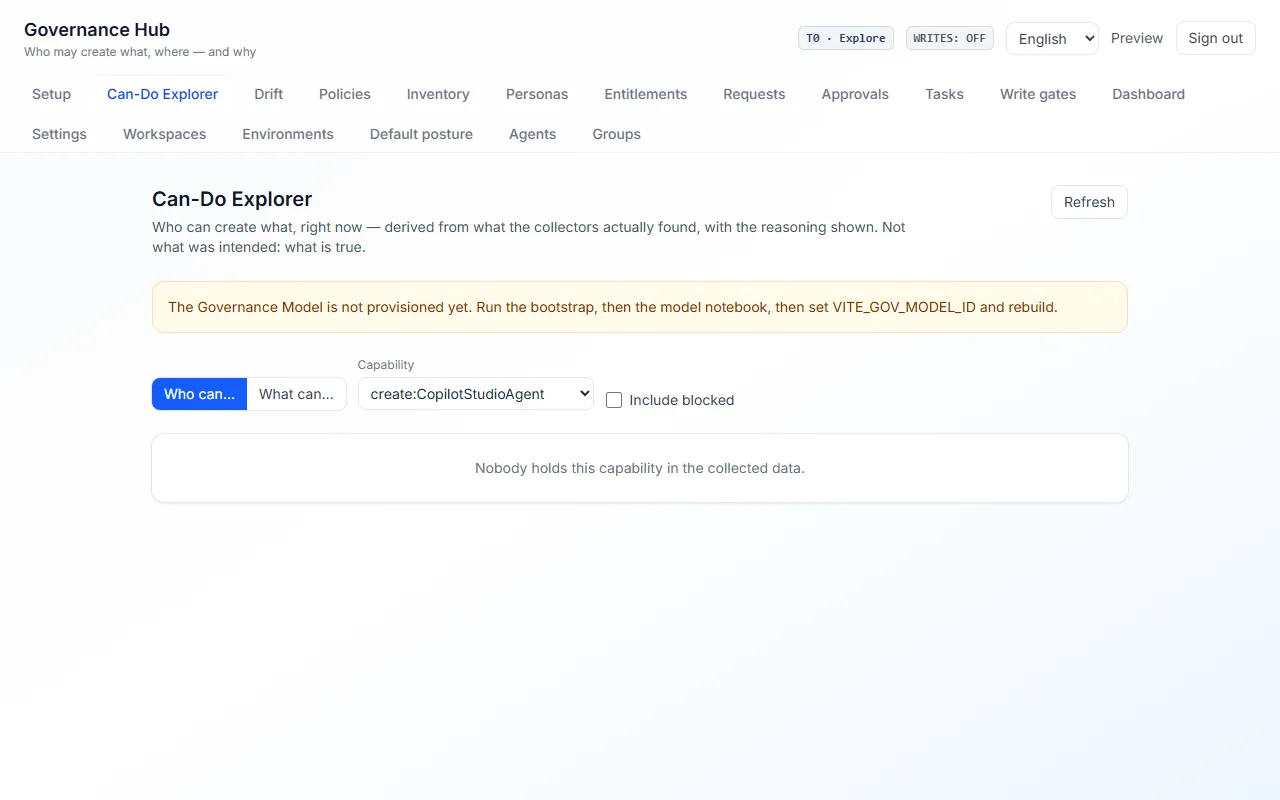
The Can-Do Explorer
The headline view. It answers, from collected reality rather than from intent:
Who can create a Copilot Studio agent / a Power App / a Fabric data agent / a Power BI report — right now, and why?
Every answer carries a derivation path, because an answer an admin cannot argue with is one they will not act on:
Marcel can create:CopilotStudioAgent in environment "CoE"
  1. member of "GOV-PP-ENV-CoE-AgentAuthor"
  2. environment "CoE"
  3. role "Agent Author"
  4. role "Agent Author" has Create on bot (Organization)
Three behaviours matter more than the table itself:
| Behaviour | Why |
|---|---|
Everyone is a real answer |
A tenant setting enabled org-wide, or the Default environment where Environment Maker is auto-assigned and cannot be removed, genuinely grants to everybody. Rendering that as an empty list would be the most misleading thing this app could do. |
Unknown ≠ nobody |
M365 declarative agents are admin-center-only with no API. Reporting “nobody can” would be the opposite of the truth in most tenants. |
| A failed source is announced | If a table could not be read, the answer under-reports access — the dangerous direction for a governance answer to be wrong in — so the page says so instead of quietly returning less. |
Drift, policies and the Default environment
Entitlements record who should hold which persona in which scope. Recording one changes nothing in any control plane — it only describes intent, so the gap is visible long before a write gate is armed.
Drift compares that intent against what the collectors actually found:
| Type | Meaning | Auto-fixable |
|---|---|---|
Missing |
entitled, but the capability is not held | yes — granting what was already approved |
Extra |
held, but no entitlement justifies it | never |
Blocked |
entitled and nominally granted, but a tenant setting blocks it | no |
Unknown |
held, but the platform cannot tell us whether it is effective | no |
Extraaccess is reported, never revoked automatically. Auto-revoking is how a governance tool takes production down at 03:00. Removal is always an explicit human decision. This is asserted by test across every capability, not just documented here.
Policies ship as POL-001…027. Rules whose data is not collectable yet are listed as
pending with the reason, never silently skipped — a pack that quietly drops half its
rules produces a clean report and false comfort.
Default-environment posture scores the six containment levers that actually work for the
one environment whose membership cannot be controlled (a security group cannot be bound to
it, and Basic User + Environment Maker are auto-assigned in a way that survives the
opt-out). All six are licence-free and none needs Managed Environments. An un-run
collector scores unknown, never fail: not having looked is not evidence of a wide-open
tenant.
The write path
Nothing in this app writes to a control plane. Every privileged change goes through one
Fabric notebook — Gov Actuator — which re-evaluates all four gates server-side on every
call:
| Gate | Ships as | Refusal |
|---|---|---|
| 1 · master switch | off | gate:master |
| 2 · armed binding kind | none armed | gate:kind |
| 3 · scope allow-list | empty | gate:scope |
| 4 · a successful dry run for this kind × scope in the last 30 days | no evidence | gate:dryRun |
Plus invariants no configuration can override: Admin / Owner / System Administrator /
Global Administrator are never granted, a switched-off module cannot be written to, and a
manual-only binding kind is never written however hard someone arms it.
Three properties are worth stating plainly, because a customer security team will ask:
- The app cannot grant itself permission. The gate configuration is read from
gov_configinside the notebook. The app's own evaluation exists only to explain a refusal before the click; when the two disagree, the notebook wins. - The app cannot forge its dry-run evidence.
gov_dry_runsis written only by the actuator, and only when a dry run actually succeeded. A dry run that errored earns nothing. - Every attempt is audited, including refusals. A refusal nobody recorded is indistinguishable from a write that never happened.
The gates are implemented twice — TypeScript for the UI, Python for the actuator — against one shared specification in spec/write_gate_cases.json that both test suites run. Two implementations of one rule set drift silently, and here the drift would mean the tool writing something it promised it would not.
Requests → approvals → verification
The front door. Somebody asks for a persona in a scope; an approver decides; approving does three things in this order:
- write the entitlement — the desired state drift is measured against;
- apply the compiled bindings through the four write gates;
- verify by re-reading the plane.
Step 1 comes first on purpose. If the write fails, the customer is left with an approved
entitlement that drift immediately reports as Missing — visible, explainable, retryable.
The reverse order leaves access in the tenant that no entitlement justifies, which is exactly
the state this tool exists to eliminate.
Rules that are enforced, not just documented:
- Nobody approves their own request. An approval chain of one is not an approval chain, and it is the first thing an auditor tests.
- "Approved" never means "applied". A request whose bindings were refused by a gate lands
as
Failedwith the gate named. A request that compiled to nothing also lands asFailed— telling a requester they can now do something they cannot is the worst outcome available. - Verification is not an HTTP 200. It asks the same effective-permissions engine the Can-Do Explorer uses whether the principal now actually derives what was promised.
- Executors read before they write. Re-running a grant is
already_present, never a duplicate — a duplicate assignment makes the later revoke ambiguous.
What the end-to-end test proves, and the demo should say out loud: after a successful "report author in Finance" request, the
Missingdrift closes — and threeExtrarows remain:create:FabricItem,create:FabricDataAgent,create:FabricApp. That is not a defect. Fabric has no per-item-type role, so the only way to grant report authoring isContributor, which grants those too. The tool cannot fix it, and it refuses to hide it.
The licence position, machine-checked
This tool needs no premium licence to run, and its Power Platform controls work without Managed Environments. That is a claim worth making only if it is checkable, so every binding kind records its licence impact and a test fails if any kind is missing one.
| Binding | Licence impact |
|---|---|
| Entra group membership · Fabric workspace role · Fabric tenant setting | free |
| PP environment security group · Dataverse role (group team) · data policy · tenant isolation · tenant settings | free |
| Managed Environments | makes a premium licence a requirement for active usage |
Managed Environments is therefore the one binding kind flagged
enables-premium-requirement — and it is never registered as an executor. A governance
tool must not change a customer's licence position as a side effect of granting somebody
access. The Write-gates console says so before the kind can be armed, and the Approvals page
states the licence impact of a request before it is approved.
Two Power Platform executors refuse work on principle rather than on permission:
pp_dataverse_rolewill not target an individual. A role held by a person is access that no group membership explains: the Can-Do Explorer cannot derive it, and revoking it means hunting down every individual row. Group team or nothing.pp_env_security_grouprefuses Default and Developer environments with the real reason — a security group cannot be bound there. Failing with a raw API error would send an admin hunting for a permission that would not have helped.
What you give up without Managed Environments is stated as capability loss, not as a reason to buy: Default-environment routing, environment groups, proactive sharing limits, solution-checker enforcement, usage insights, IP firewall, CMK, vNet.
The honest half: tasks
Five binding kinds have no write API at all — org-app audience membership, Microsoft 365 Copilot agent access, Agent 365 registry actions, Power Platform routing rules, and Fabric item-level permissions. The tool cannot do them, so it hands each one to a person with the exact click-path and a link to the right portal.
The distinction that makes this a governance feature rather than a to-do list:
| State | Means | Set by |
|---|---|---|
| Attested | "I did it" — a claim, attributed by name and time | a human clicking |
| Verified | the plane was re-read and confirms it | a machine check only |
They are counted separately and styled differently — Attested is deliberately not green — because a queue where a click becomes governance evidence is worse than no queue, since it launders a claim into a fact.
Of those five kinds, exactly one can be machine-verified today (the Agent 365 registry exposes list and get, even though the actions are UI-only). The page says so, and shows the count of work that can never be proven by machine. That is a property of the platform, not of this tool — and stating it is more useful than a queue that looks uniformly green.
Deep links go to the portal root, never to a guessed blade URL: these admin surfaces reorganise regularly, and one link that 404s destroys trust in the whole queue.
414 TypeScript tests + 170 Python tests, including seven structural guards that keep the design honest:
- Module boundaries — no module may import another; nothing outside
src/modulesmay reach into a module folder. Enforced by both a test and an ESLint rule. - i18n parity — DE must define exactly EN's keys, with identical placeholders, no empty strings, and no ASCII umlaut substitutes.
- No literal user-facing strings in components.
- The T0 exit criterion itself — a render test asserts that a user with no admin consent sees real objects, per-plane gap reasons and the tier badge, in both languages.
- Notebook integrity — every generated
.ipynbmust parse as valid Python, carry exactly oneparameterscell, contain the inlined shaping layer, default todry_run = True, and match the current source. - Schema agreement — the TypeScript table catalogue, the bootstrap notebook and the semantic-model notebook are three descriptions of one schema; a test fails the build if any of them drift.
- Write-gate conformance — the TypeScript and Python gate implementations are checked against one shared case file by both suites, and every gate id must be exercised by at least one case.
Prerequisite runbook
Work through this in order. The in-app Setup page checks each item live and gives you the exact command to fix it.
1. Fabric
- A Fabric capacity (F2+) and a workspace to deploy into.
- Fabric Administrator for tenant-wide read (T1). Prefer PIM elevation over standing rights.
- Tenant setting "Service principals can access admin APIs used for updates" — needed later for writes.
2. App registration (SPA)
- A public-client app registration for the Power BI / Graph token hops.
- Delegated permissions: Power BI service, plus Graph
User.Read. AddDirectory.Read.All/Group.Read.Allto lift the Entra module to T1.
3. Power Platform — one step only a human can do
A service principal cannot register itself. A Power Platform Administrator must run this once, interactively:
New-PowerAppManagementApp -ApplicationId <your-app-registration-client-id>
⚠️ Understand what this grants before you run it. A registered management app is "treated like a normal user with the Power Platform Administrator role assigned", and "granular roles and permissions can't be assigned to limit their capabilities." There is no least-privilege model for the BAP admin API. Compensating controls: scope the Dataverse application user with a purpose-built role per environment, keep the write gates tight, and read
gov_audit. This is disclosed here deliberately — your security team will find it anyway, and finding it themselves is worse.
4. Deploy
npm install
npm run build:fabric
npx rayfin up --workspace-id <workspace-id> --tenant <tenant-id> -y
5. Bootstrap
python bootstrap/build_ipynb.py
# upload the .ipynb files to the workspace, then set the notebook ids in .env
Then, in the app: Setup → Preview bootstrap (dry run) first. It reports
Created | Already present | Skipped (no permission) | Failed for every step and changes
nothing. Run it for real once the preview looks right. It is idempotent — a second run
must report Already present throughout.
6. Semantic model
Run Gov Create Model once, then put the model_id it returns into VITE_GOV_MODEL_ID
and rebuild. The module pages then read live data.
⚠️ It refuses to recreate an existing model by default. Regenerating changes the model id, which silently breaks the deployed app's config — and the failure looks like "the collectors are broken". Later tables must be added with TOM
add_tablein a migration.
6. Configure
Copy .env and fill in your ids. Nothing tenant-specific is hard-coded anywhere; a
customer deployment is a config file, not a fork.
7. The write path (optional — the app is fully useful read-only)
Upload Gov Actuator and set VITE_GOV_ACTUATOR_NOTEBOOK_ID. Until you do, the app
cannot write anything at all, which is the safe default and costs you nothing: drift,
policies, the Can-Do Explorer and the posture score are all read-only.
Then, in Write gates: turn on the master switch, arm one binding kind, add one concrete scope, and press Dry run. Only after that dry run succeeds will gate 4 let the real write through — for that kind and that scope, for 30 days.
Development
npm install
npm test              # 414 TypeScript tests
npm run test:py       # 170 collector, gate and actuator tests (offline, no tenant needed)
npm run lint
npm run build:fabric  # tsc -b && vite build
npm run notebooks     # rebuild all .ipynb from percent-cell source
Adding a fifth control plane should be a folder under src/modules/, a GovernanceModule
export, and a registry entry — never a refactor. The boundary tests exist to keep it that way.
What this is not
- Not a replacement for Entra ID Governance, Purview, Defender, or the Agent 365 registry — it consumes them (Agent 365 analysis in PLAN.md §7).
- Not multi-tenant SaaS. Self-hosted only.
- Not an ISV product: no billing, no marketplace listing, no SLA.
- Not a runtime agent security tool — that is Defender's job.
Credits
Request/approval patterns adapted from DaSenf1860/fabricplatformgovernance by Andreas J. Rederer (MIT). Built on Rayfin and the Fabric platform.
Fabric architecture
npx rayfin up provisions:
- Entra sign-in (Fabric identity)
- Fabric SQL database
- Static web app
Getting started
npm install
npm run dev
npx rayfin up --workspace-id <your-workspace-guid> --tenant <your-tenant-guid>
Any workspace or item id this app needs is read from the environment, with no default.
Project structure
bootstrap/      one-off setup notebooks
collectors/     scheduled collectors
rayfin/         deployment config - redirect URIs are loopback only
spec/
src/            the application
Scripts
| Script | What it does |
|---|---|
npm run bench |
|
npm run build |
production build |
npm run build:fabric |
build the bundle Fabric static hosting serves |
npm run dev |
dev server on http://localhost:5173 |
npm run lint |
lint |
npm run notebooks |
|
npm run rayfin:up |
deploy to your Fabric workspace |
npm run test |
unit tests |
npm run test:py |
Data
Your own tenant, read with your own identity. Nothing is bundled.