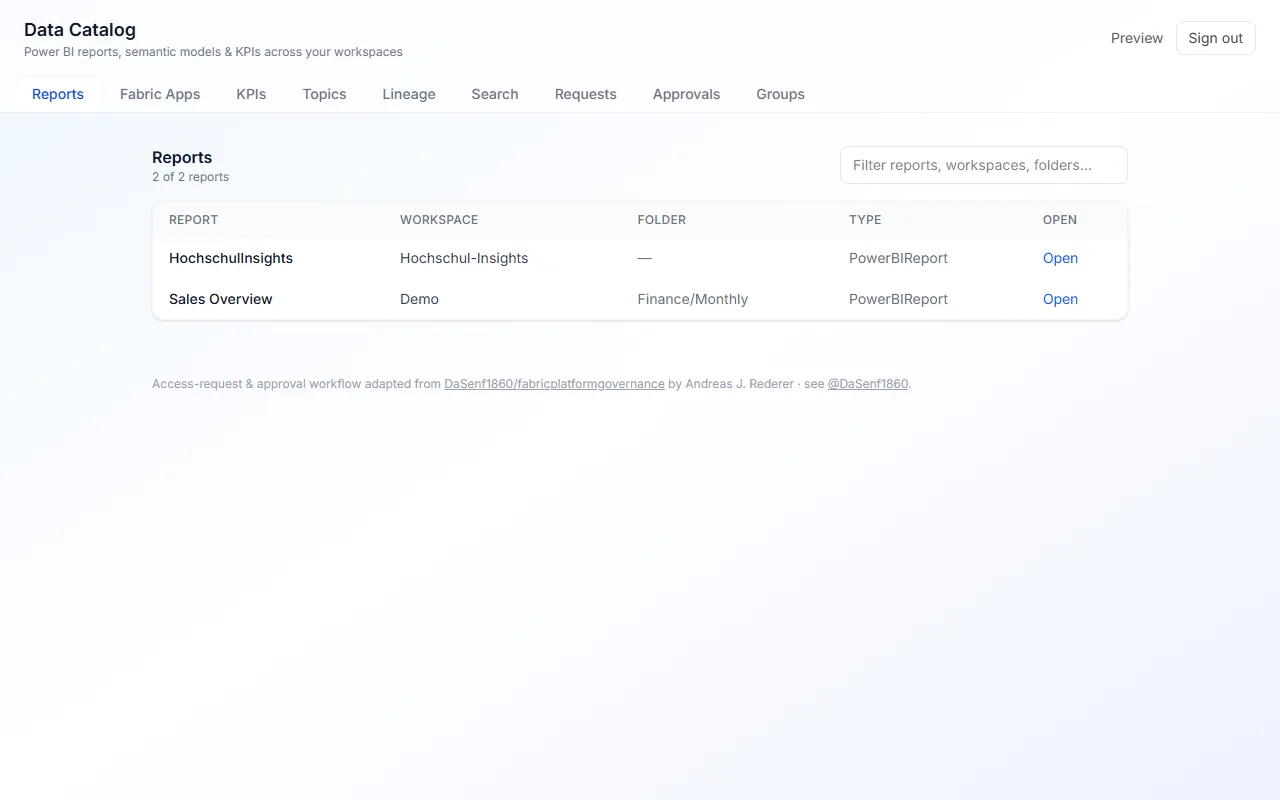
A Fabric-wide catalog of Power BI reports, semantic models, and their KPIs (measures / columns), with reverse lookup (which KPI is used in which report), lineage, a topic (workspace + folder) tree, global search — and an access-request front door.
Full design & phases: PLAN.md.
What it does
- Every workspace and item in your tenant, scanned on a schedule into a Lakehouse
- Lineage and ownership per item
- Search across the whole tenant
- Runs entirely inside your own tenant
Architecture (two-tier)
Scanner notebook (sempy + semantic-link-labs, scheduled)
        → Catalog Lakehouse  data_catalog_lh  (Delta cat_* tables)
        → Direct Lake semantic model  "Data Catalog Model"
        → this Rayfin app (reads via fabric_proxy executeQueries UDF)
- scanner/ — the Fabric notebook that crawls every accessible workspace and writes the
cat_*Delta tables. See scanner/README.md. - src/ — the React 19 + Vite 7 + Fluent UI v9 SPA (Fabric brokered auth).
- rayfin/ — Rayfin service config (
rayfin.yml) + theAccessRequestdata entity.
Develop
npm install
npm run build:fabric   # tsc -b && vite build — must be green
npm run dev            # local dev against the mock backend
Deploy
Target: Rayfin Apps workspace ${FABRIC_WORKSPACE_ID},
tenant fc3a8969-… (MCAPS), capacity prdsweden (resume before deploy).
npx rayfin up --workspace-id ${FABRIC_WORKSPACE_ID} --tenant ${FABRIC_TENANT_ID} -y
Sign in with the MCAPS-native account you@example.com.
Status
Phases 0–8 built & deployed: scanner + catalog lakehouse + Direct Lake model, the five
views (report list · KPI→reports reverse index · lineage · topic tree · global search),
nightly refresh, and the access-request + approval workflow. Live at the hosting URL from
rayfin up.
Credits & Acknowledgements
The access-request/approval workflow and parts of the Fabric plumbing are adopted from the
open-source work of Andreas J. Rederer (@DaSenf1860) —
notably fabricplatformgovernance
and ms-fabric-sdk-core. See
CREDITS.md for the full list of adopted elements and attribution.
Getting started
npm install
npm run dev
npx rayfin up --workspace-id <your-workspace-guid> --tenant <your-tenant-guid>
Any workspace or item id this app needs is read from the environment, with no default.
Project structure
public/         static assets served as-is
rayfin/         deployment config - redirect URIs are loopback only
scanner/        tenant scanner
src/            the application
Scripts
| Script | What it does |
|---|---|
npm run build |
production build |
npm run build:fabric |
build the bundle Fabric static hosting serves |
npm run dev |
dev server on http://localhost:5173 |
npm run lint |
lint |
npm run rayfin:up |
deploy to your Fabric workspace |
npm run test |
unit tests |
Data
Your own tenant, read through the Fabric scanner API with your own identity. Nothing is bundled and nothing leaves.