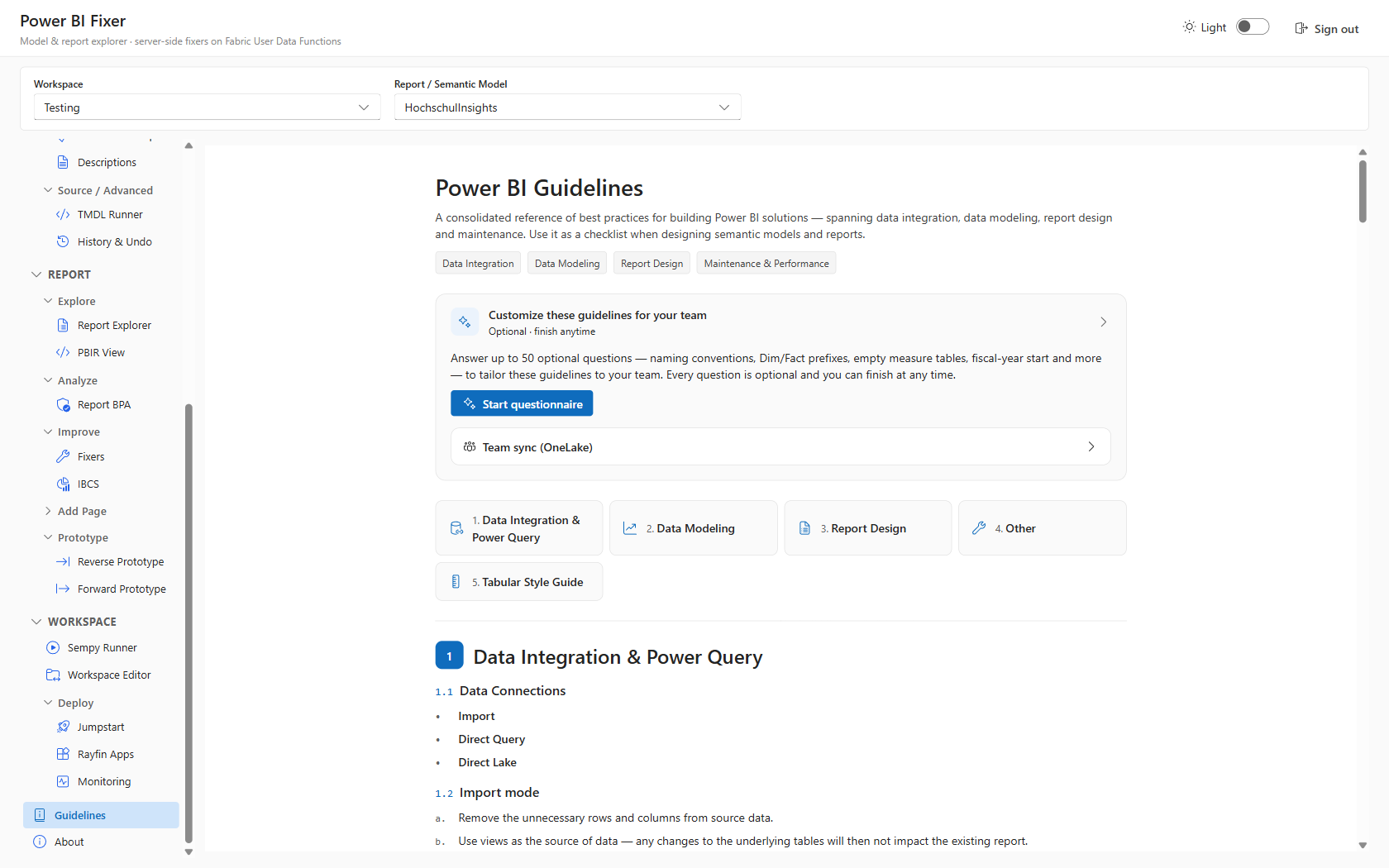
See It in Action
A visual tour through the app. Screenshots use sample semantic models and reports.
🧭 The App Shell
One unified shell — model and report tooling grouped in a single left-hand navigation, with light and dark themes.
- Sign in with your Fabric identity
- Model layer & report layer side by side
- Consistent Fluent UI v9 experience
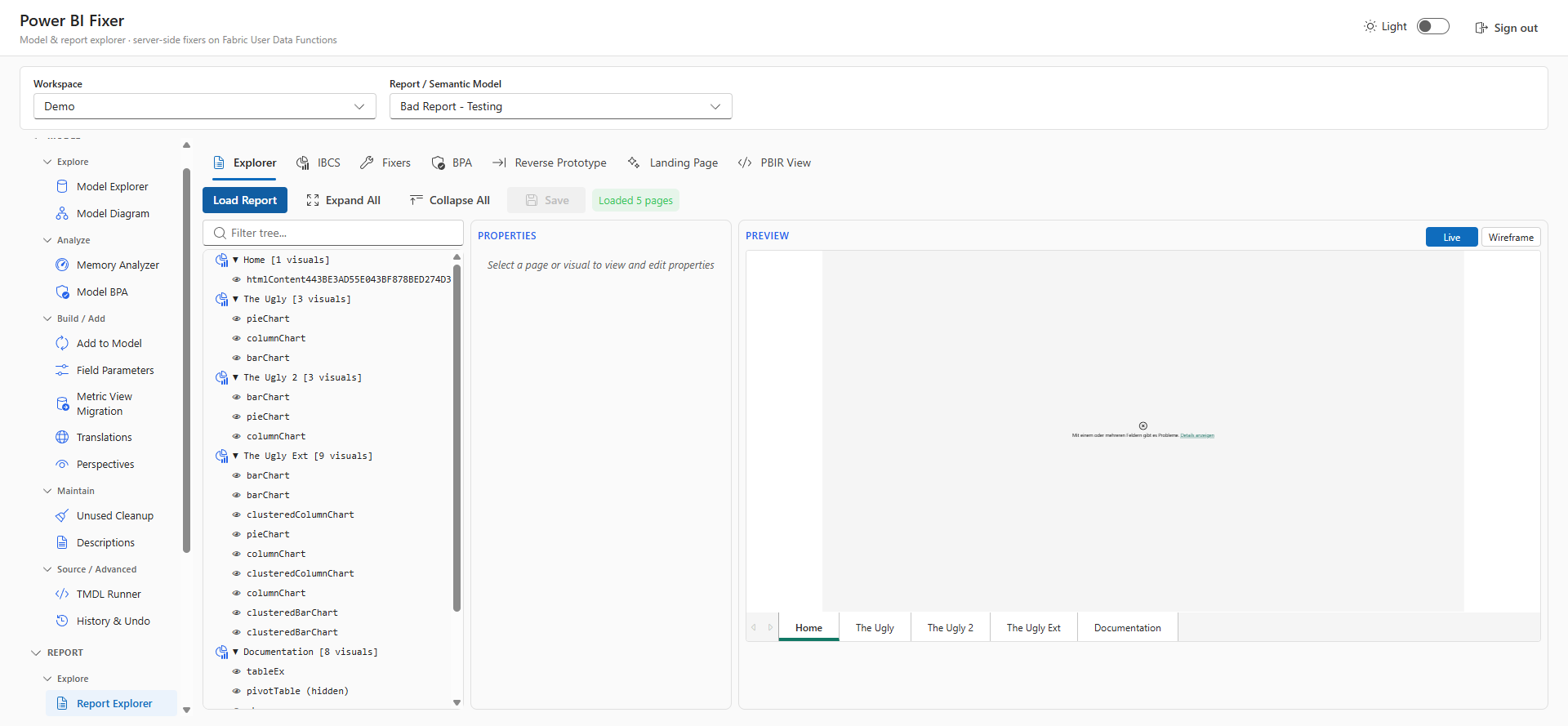
📄 Model Explorer
Edit your tabular model — browse tables, columns, and measures through a fully editable property grid, with inline TMDL, data preview, refresh, and DAX formatting.
- Full object tree with display folders
- Inline TMDL editing & live properties pane
- One-click organise actions
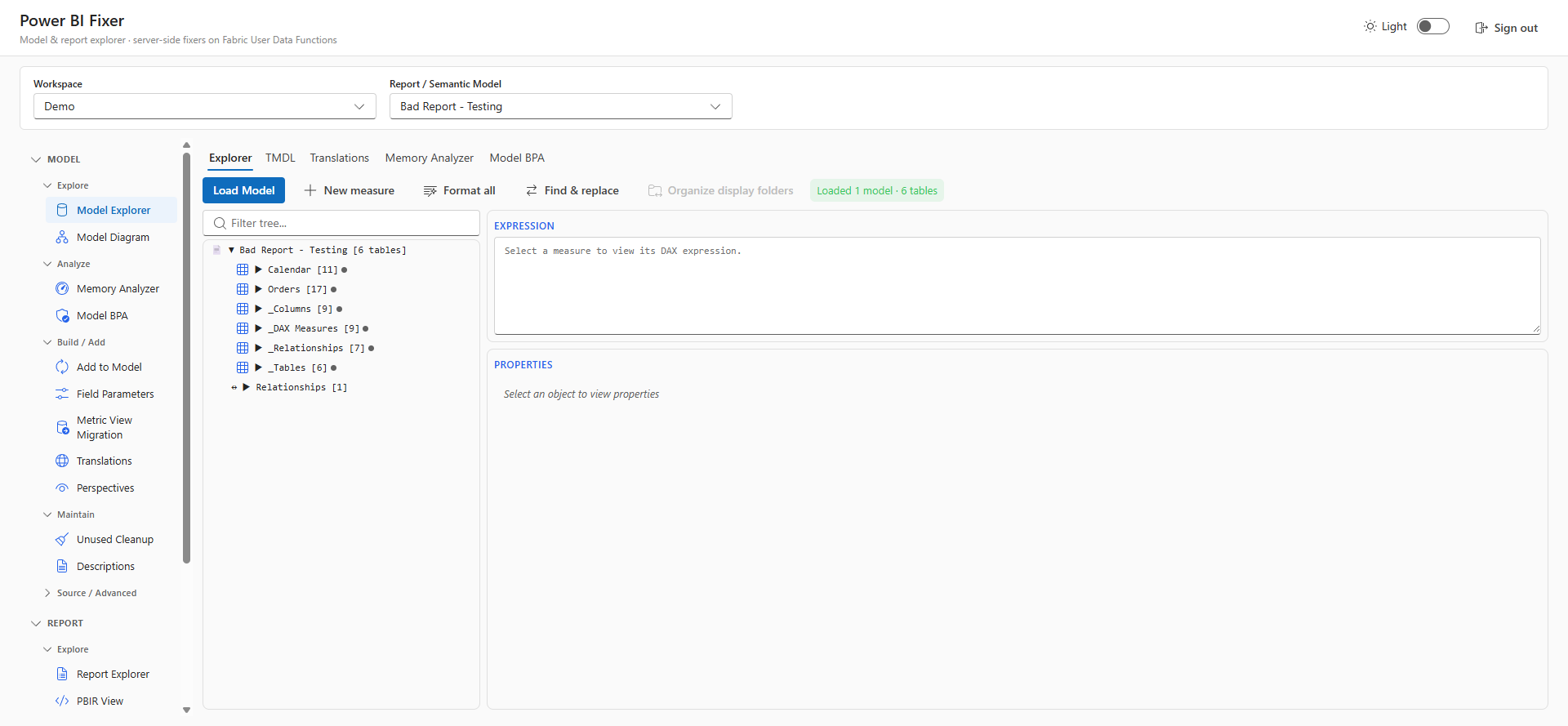
📋 Model BPA
The Best Practice Analyzer with per-rule findings, severity chips, and one-click fixes for findings the engine can repair automatically.
- Per-rule findings with severity chips
- One-click and batch auto-fixes
- Diff preview before every write-back
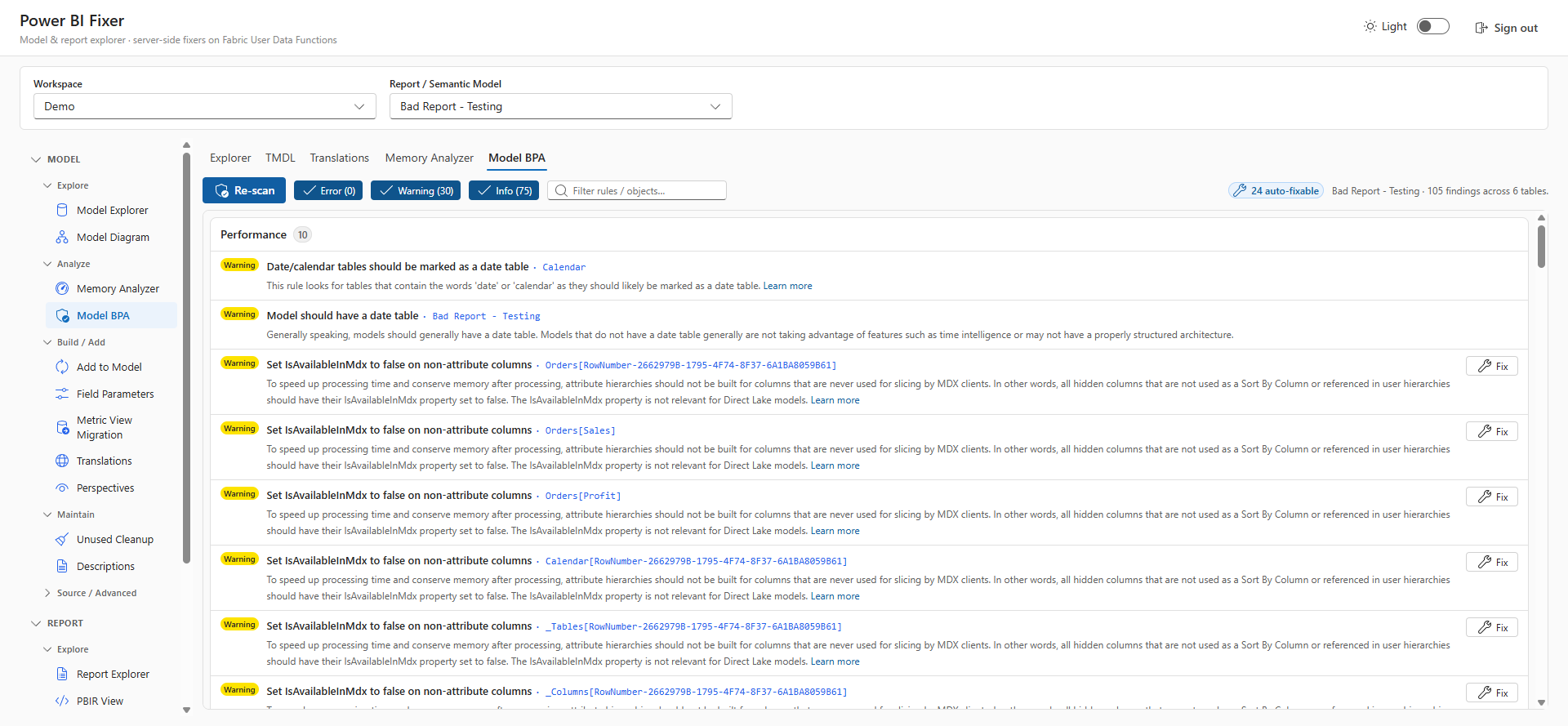
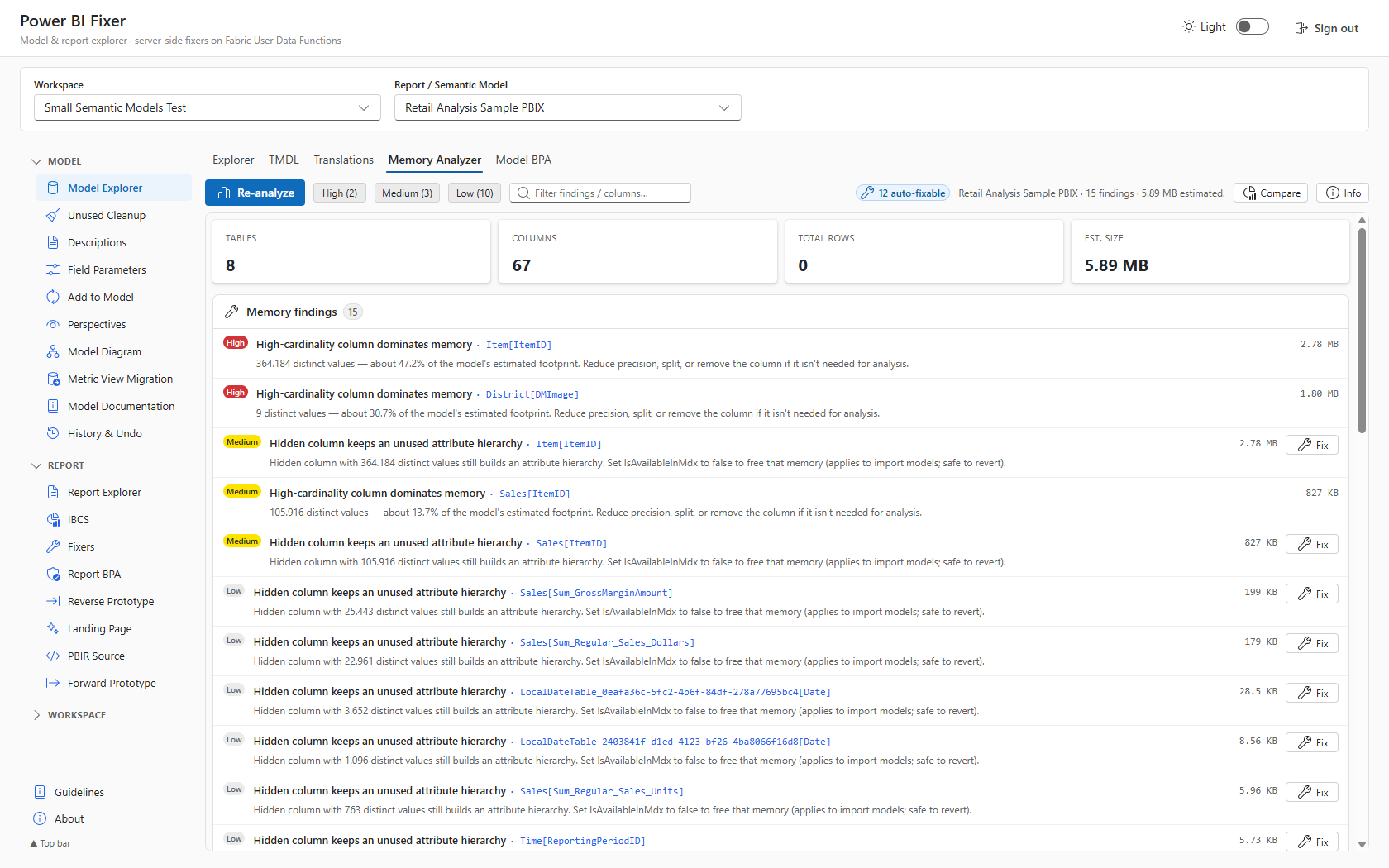
💾 Memory Analyzer
VertiPaq analysis that finds the columns eating your model size — column and table size plus cardinality insights, with auto-fixable findings to shrink the model.
- Column / table size breakdown
- Cardinality insights
- Auto-fixable findings to shrink models
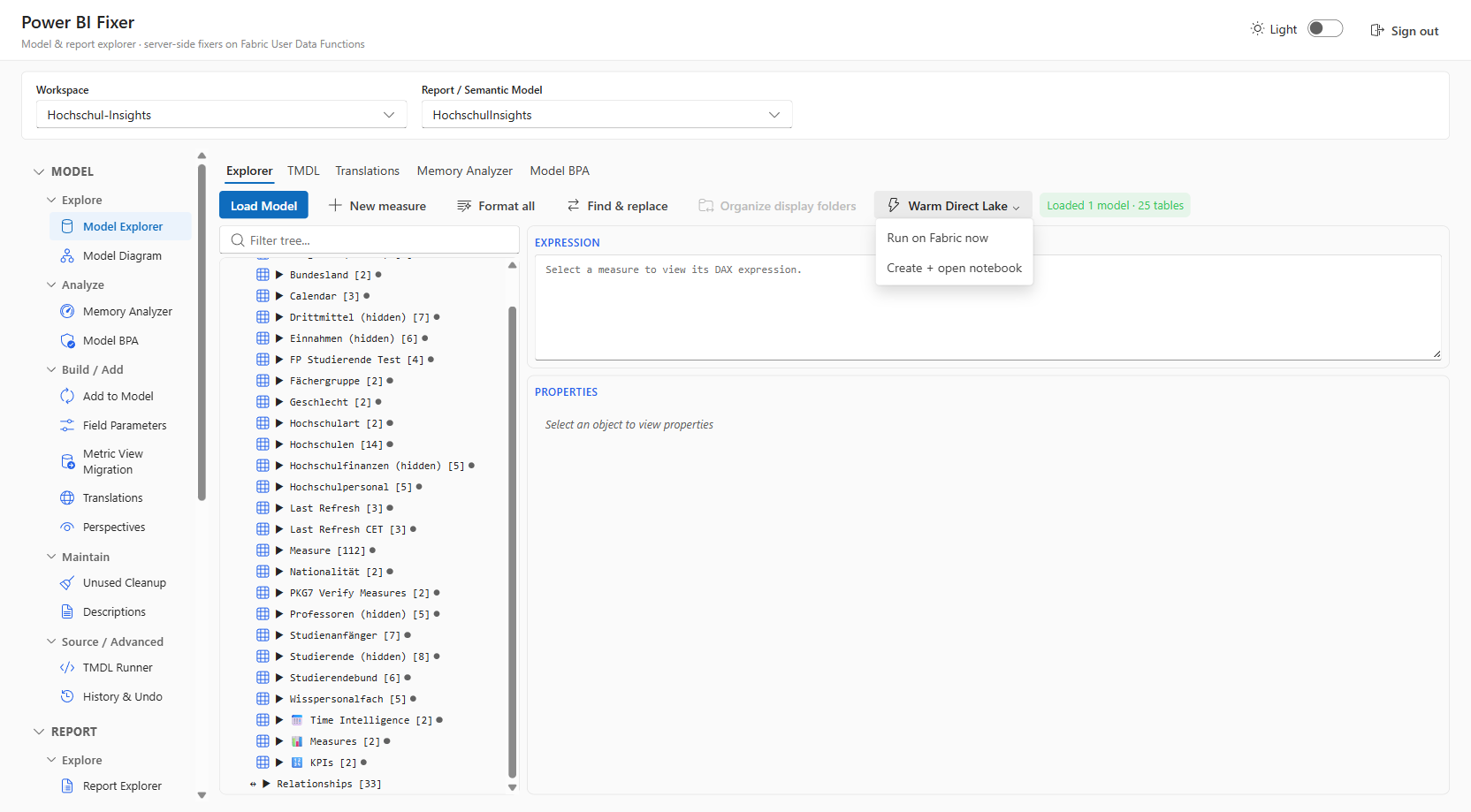
🔥 Direct Lake pre-warm
Warm the Direct Lake cache on Fabric so the very first user query hits a hot cache instead of a cold one — straight from the Model Explorer toolbar.
- Detects Direct Lake models automatically
- Run on Fabric now, or create + open the notebook
- Builds a cache-warming pass over resident columns
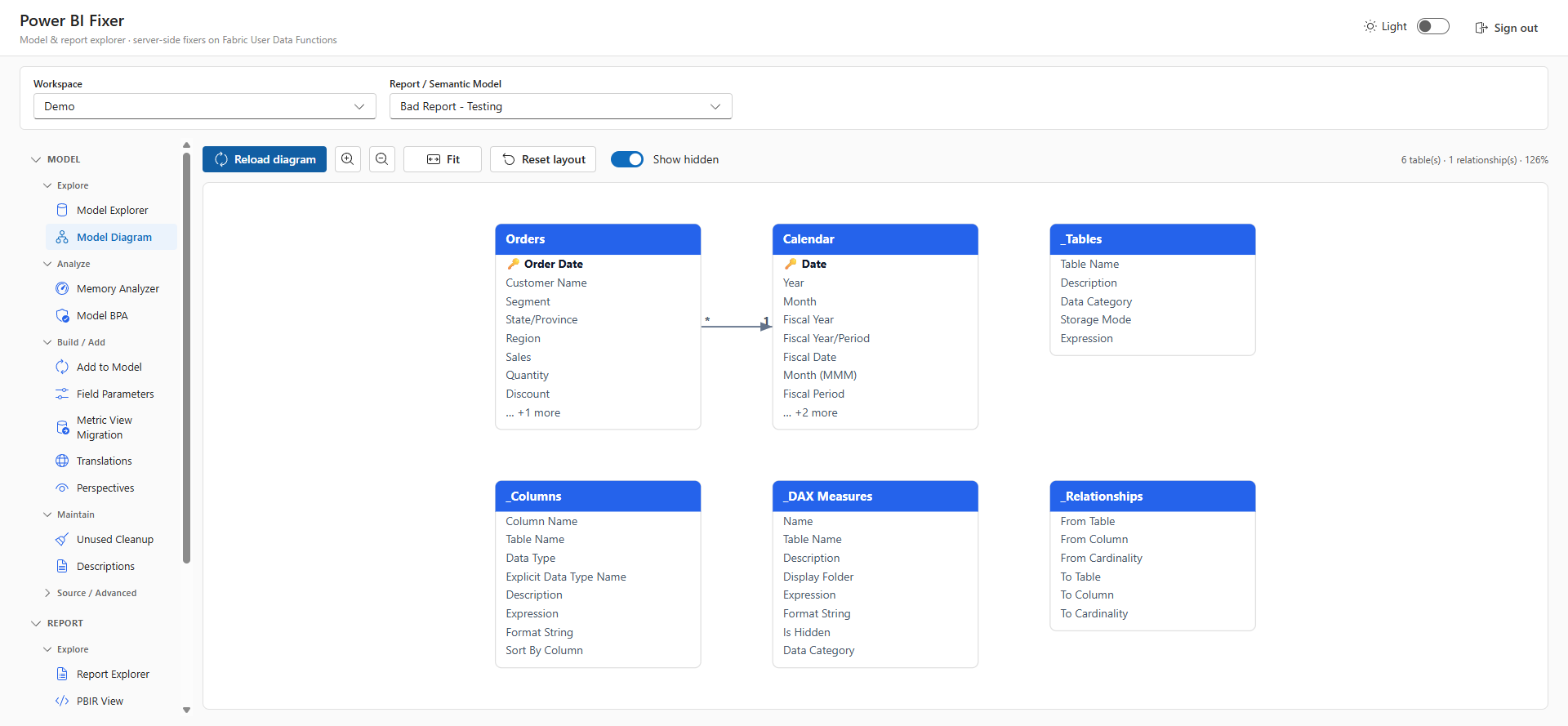
🗺 Model Diagram
See tables and relationships at a glance — a live ER diagram with layout, zoom, and hidden-object toggles.
- Live entity-relationship diagram
- Layout & zoom controls
- Hidden-object toggles
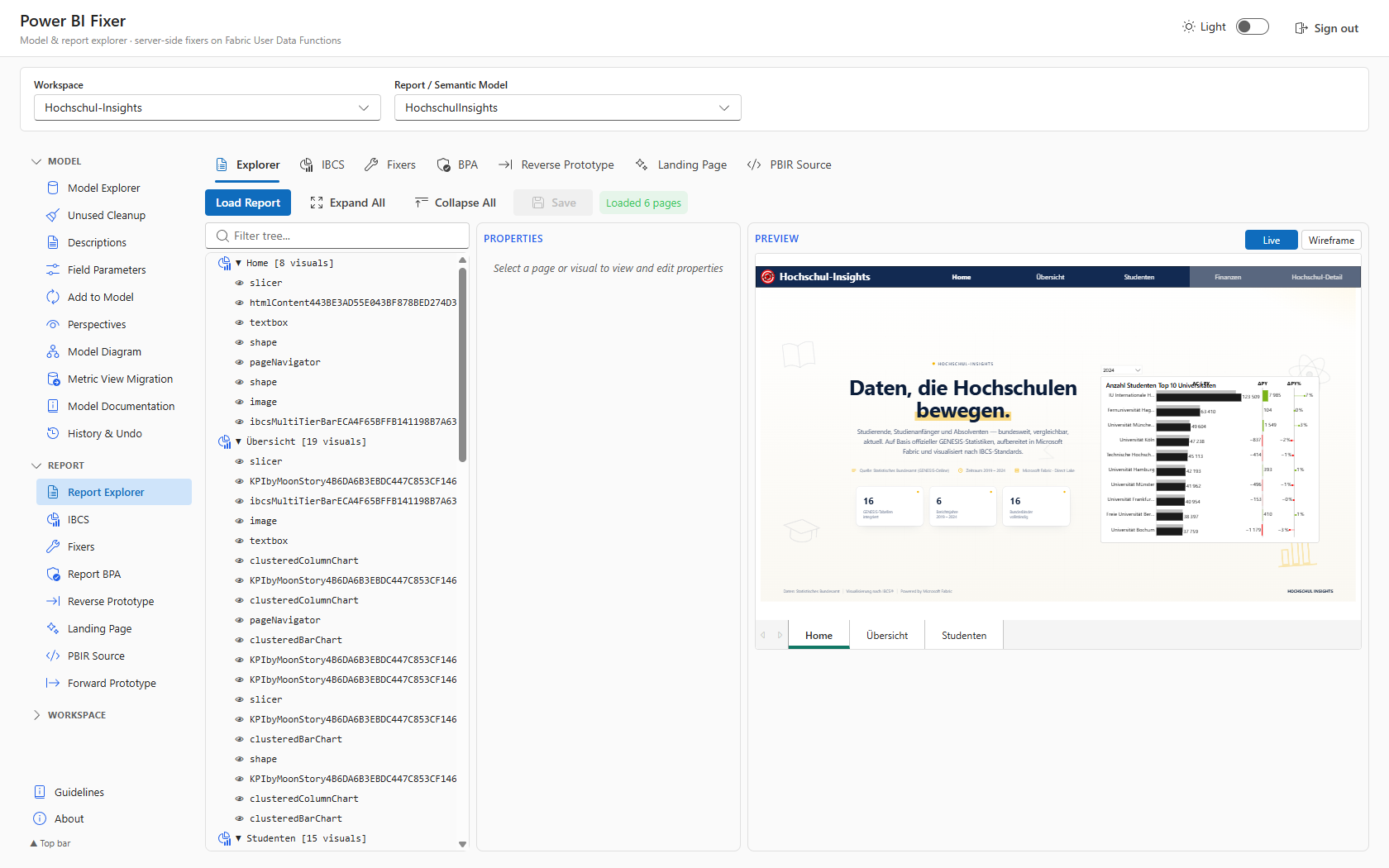
📊 Report Explorer
Walk pages, visuals, and their properties in one place — the PBIR tree with a live / wireframe report preview and an editable properties pane.
- PBIR tree navigation
- Live / wireframe report preview
- Editable properties pane
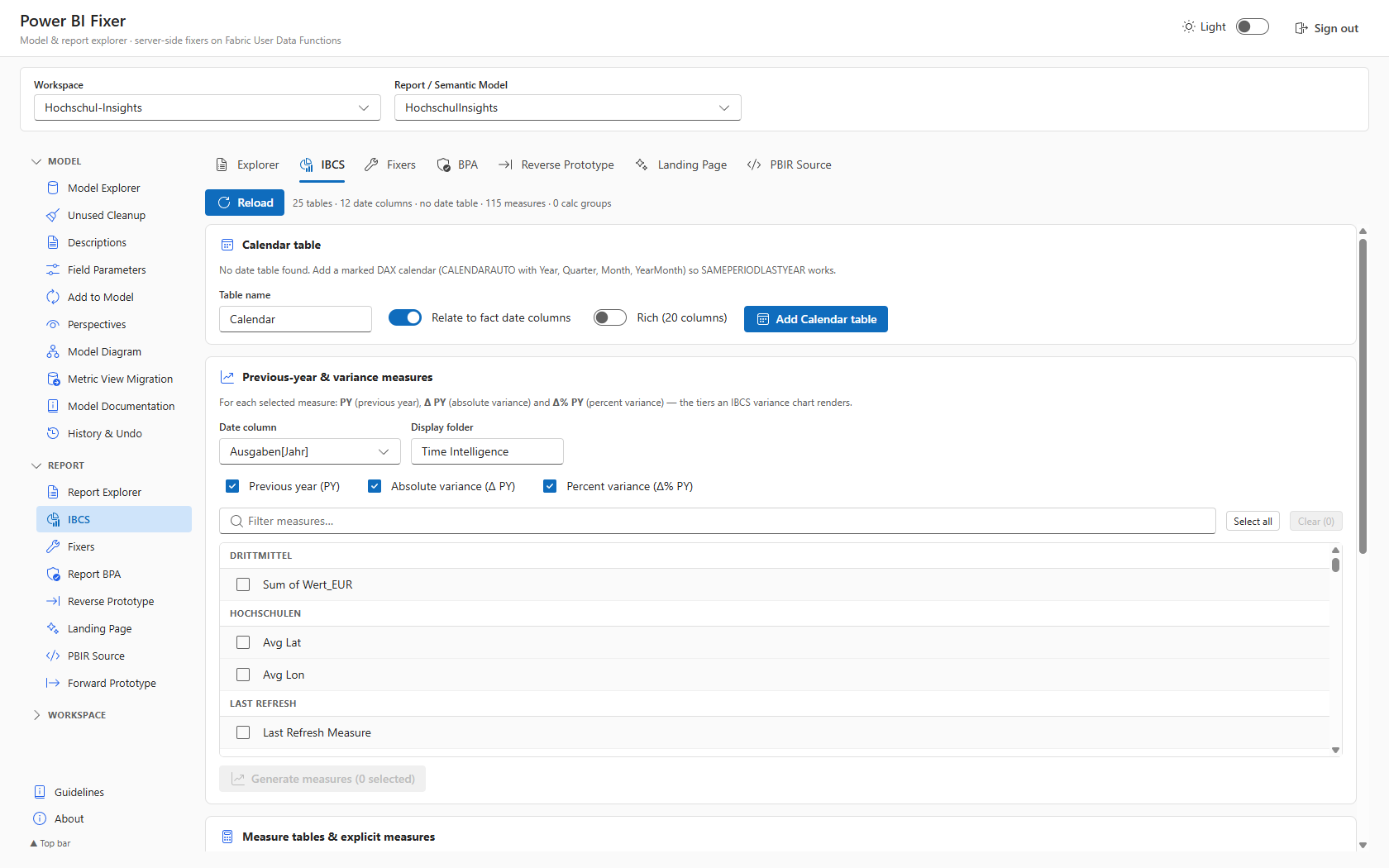
⚡ IBCS Builder
Standards-compliant calendar and measures in a few clicks — add a marked calendar table and generate previous-year & variance measures (PY, Δ PY, Δ% PY) that drive IBCS variance charts.
- Add a marked calendar table
- Generate PY, Δ PY, Δ% PY measures
- Drive notation-correct IBCS variance charts
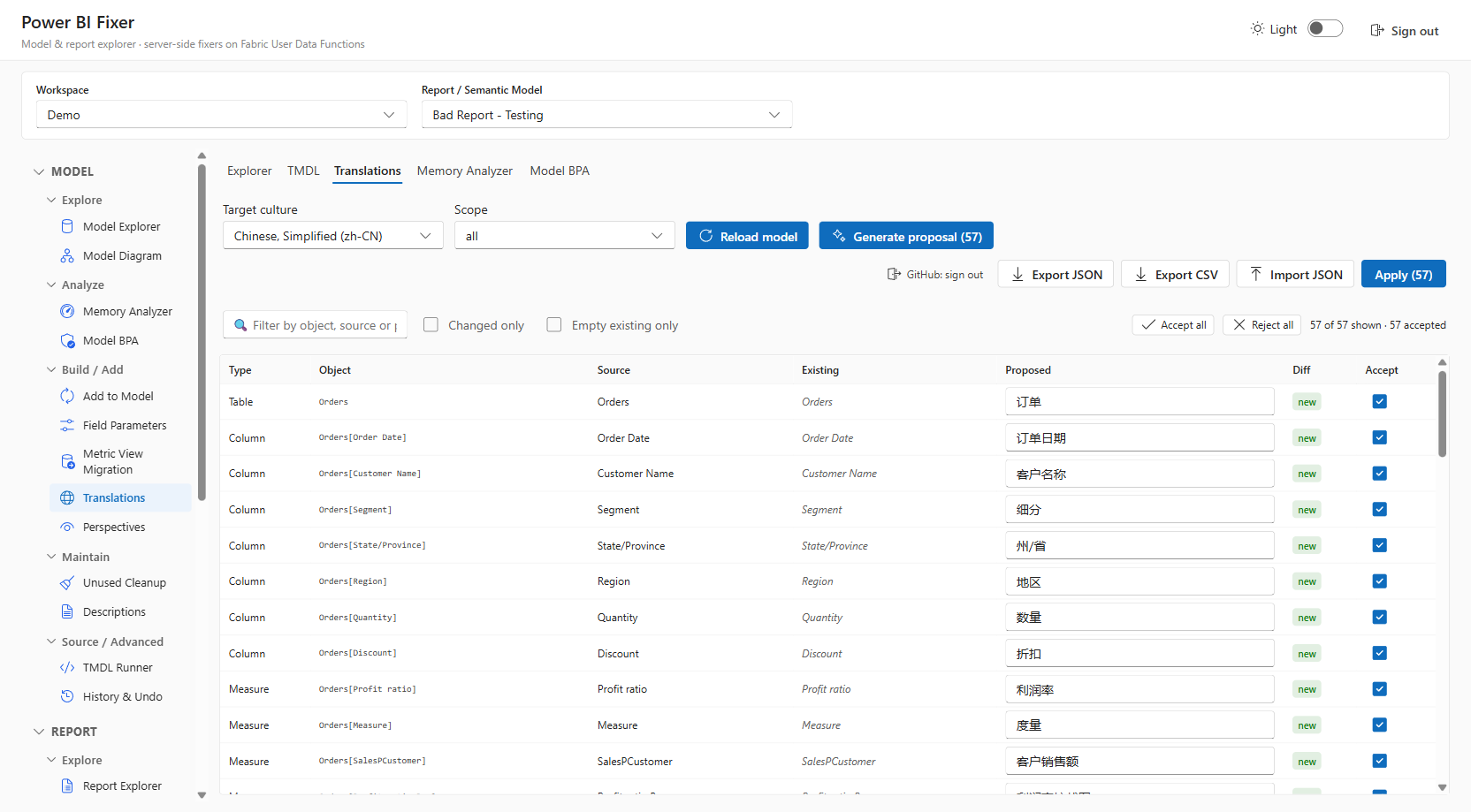
🌐 AI Translations
Generate metadata captions in 11 languages and apply them in one click — powered by GitHub Copilot via a one-time device-flow sign-in.
- Whole-model culture translations
- Powered by GitHub Copilot
- One-time device-flow sign-in
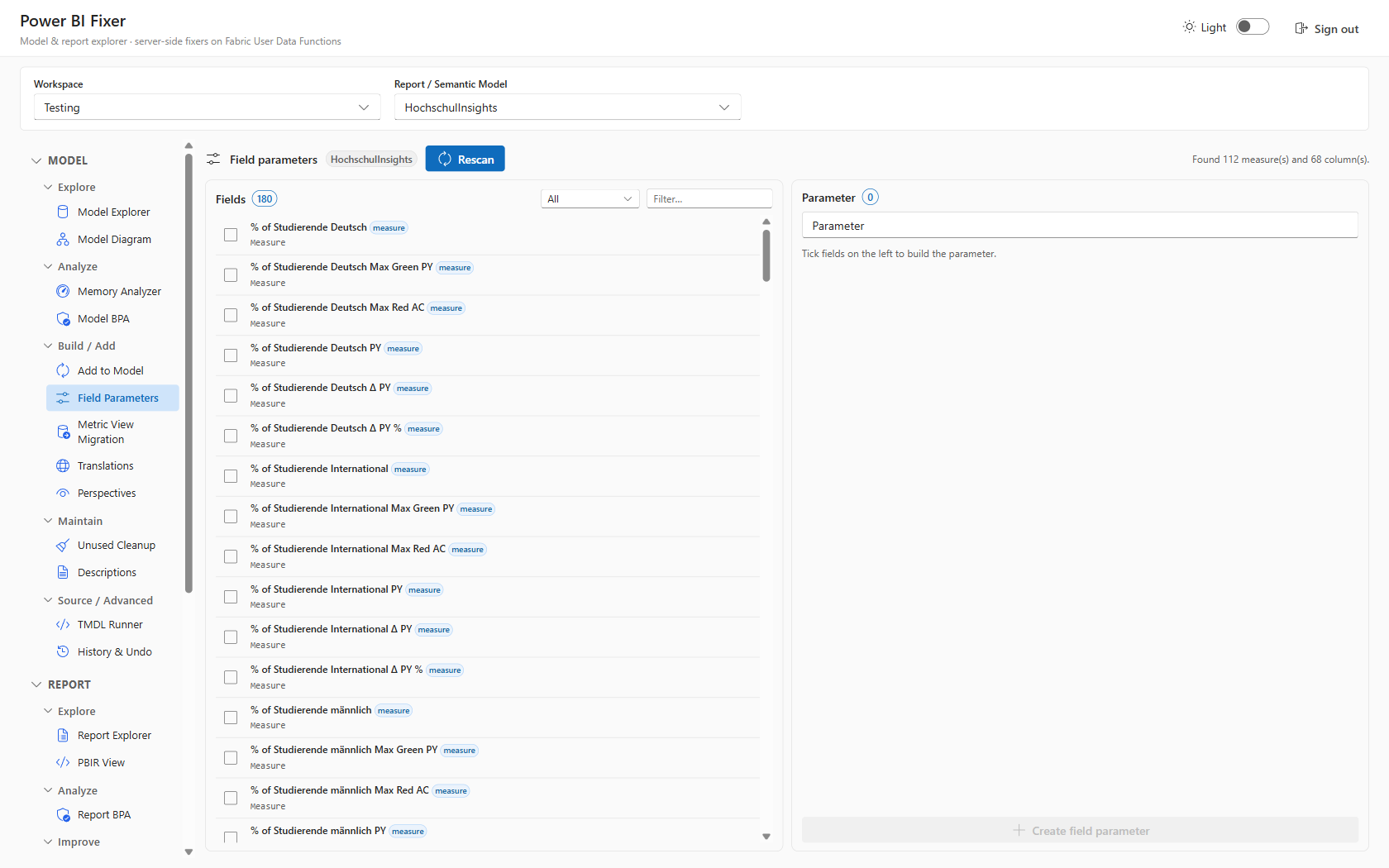
🎛 Field Parameters
Build slicer-driven measure/column switches without the DAX boilerplate — pick from a list, reorder, and preview the live TMDL.
- Pick-list of measures & columns
- Drag-to-reorder fields
- Live TMDL preview
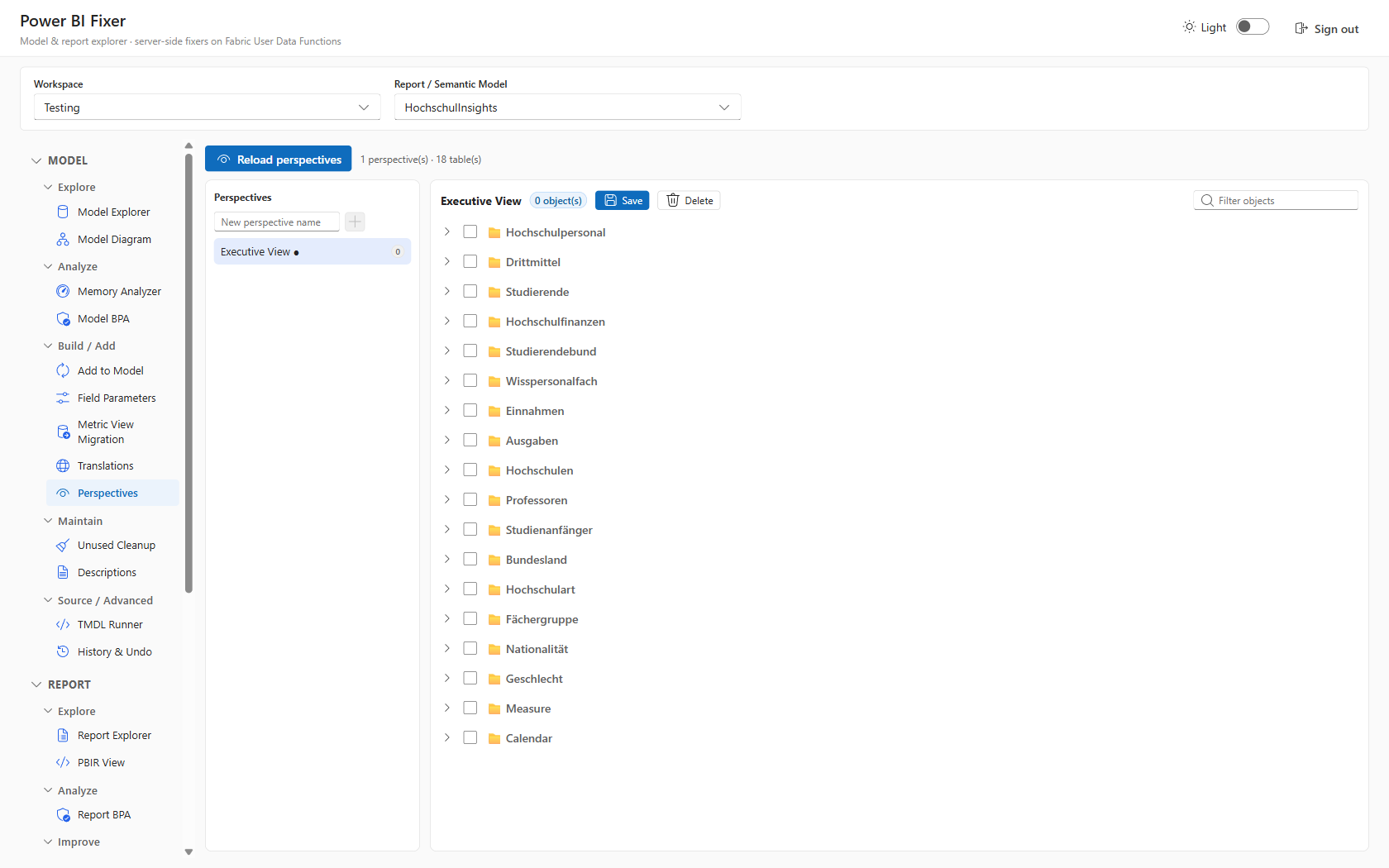
🔍 Perspectives
Curate focused subsets of the model for different audiences — tick the tables, columns, and measures each perspective should expose.
- Tri-state table / column / measure tree
- Multiple perspectives per model
- Live TMDL preview
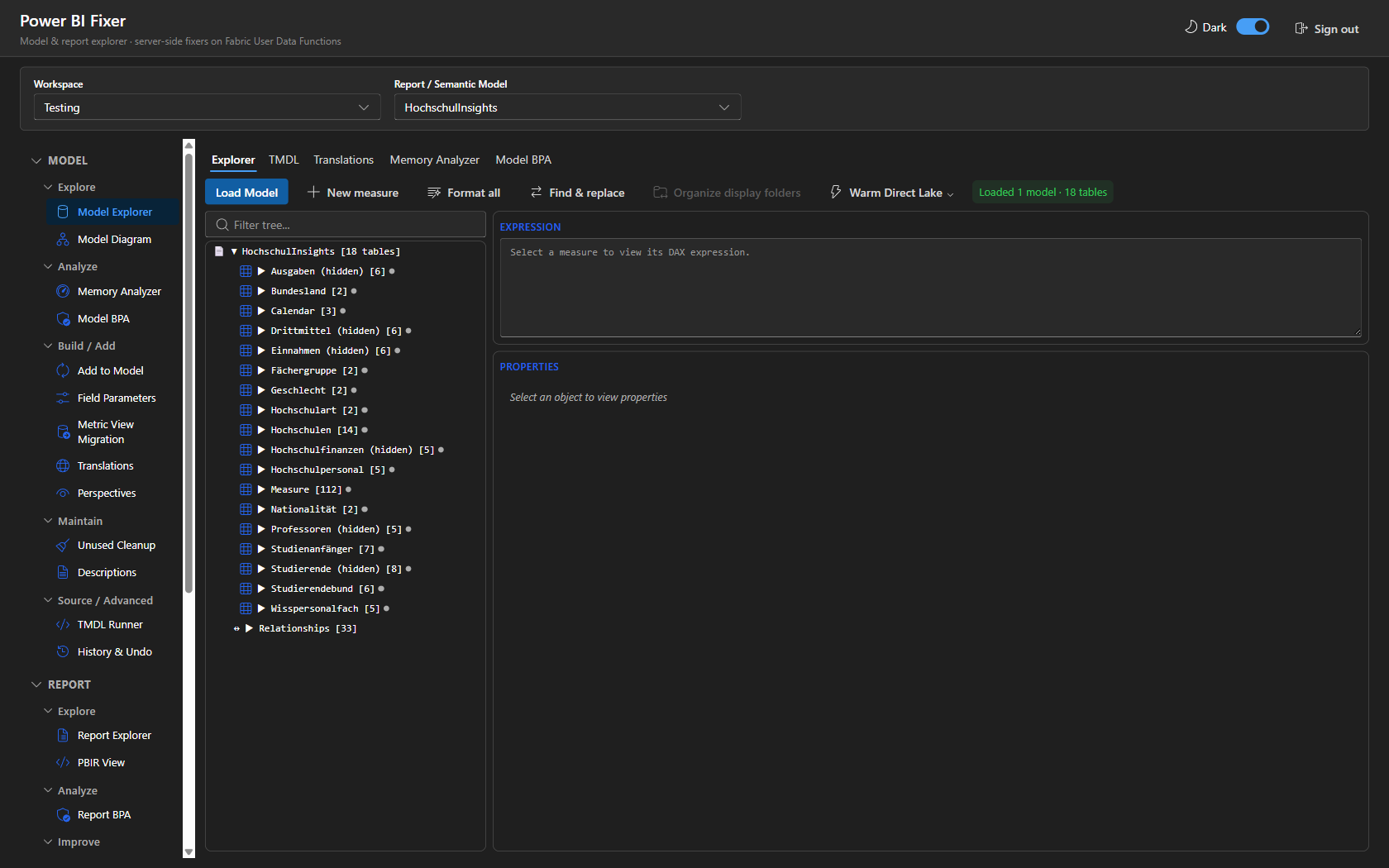
🌙 Model Explorer — Dark Theme
The same modelling workbench in dark mode, with the full object tree, expression pane, and properties panel.
- Full Fluent UI dark theme
- Object tree & expression pane
- Live properties panel
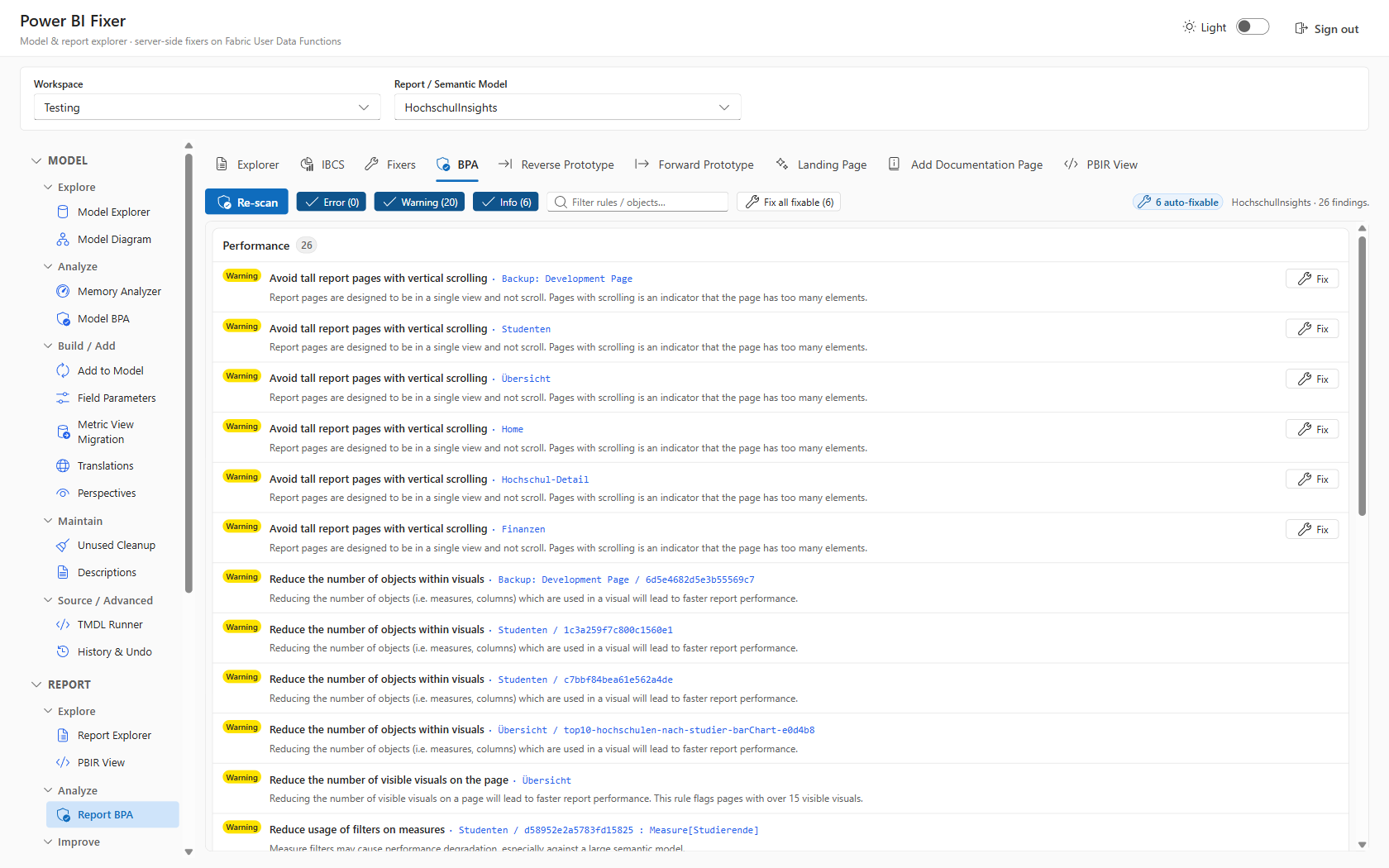
📋 Report BPA
A Best Practice Analyzer for layout and visual hygiene, with Error / Warning / Info severity filters and one-click fixes per finding.
- Report-layer best-practice rules
- Error / Warning / Info filters
- One-click fixes per finding
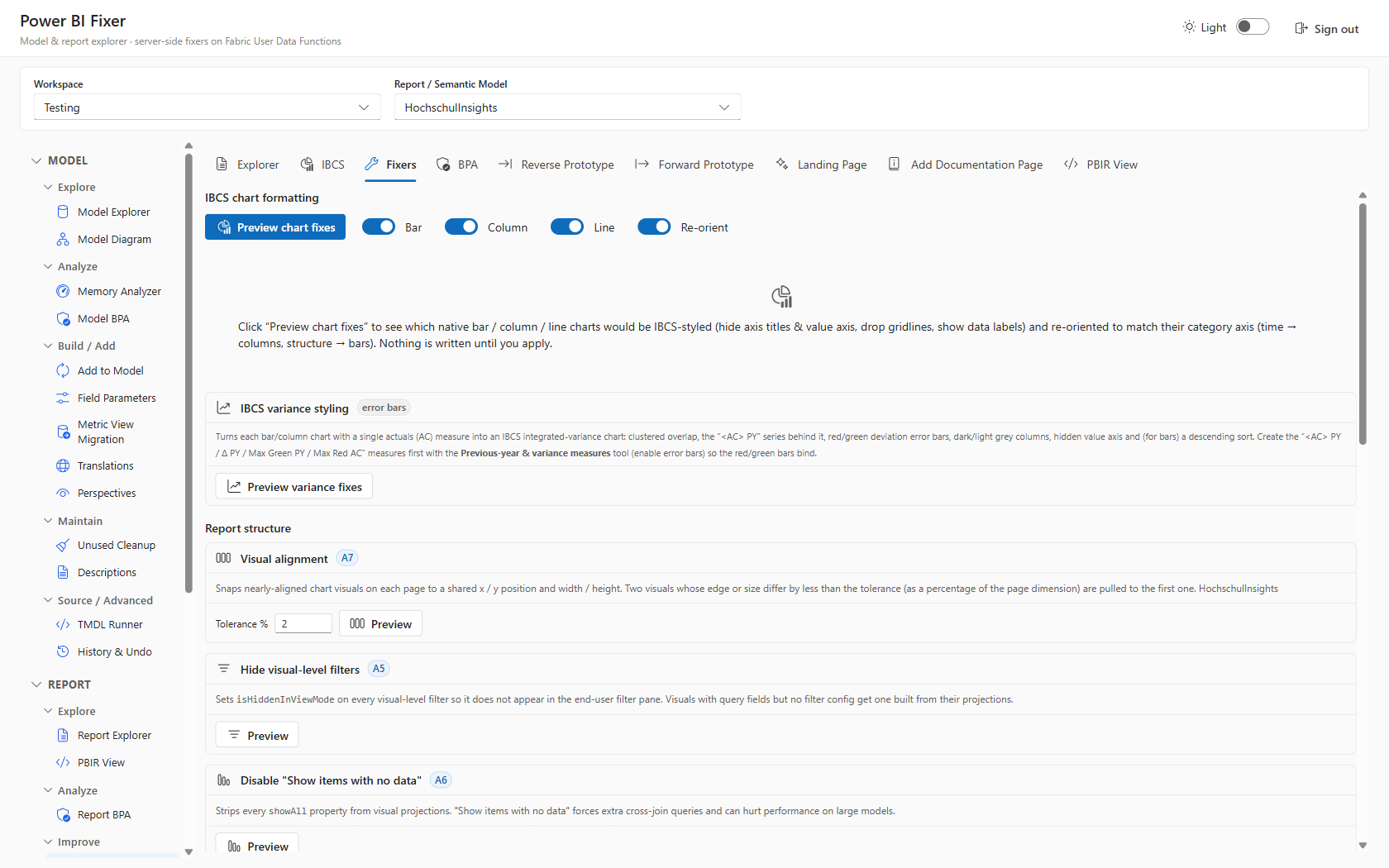
🛠 Report Fixers
Batch corrections applied across pages and visuals — IBCS chart formatting, variance styling, and report-structure clean-up straight to the PBIR.
- IBCS chart formatting
- Variance styling
- Report-structure clean-up
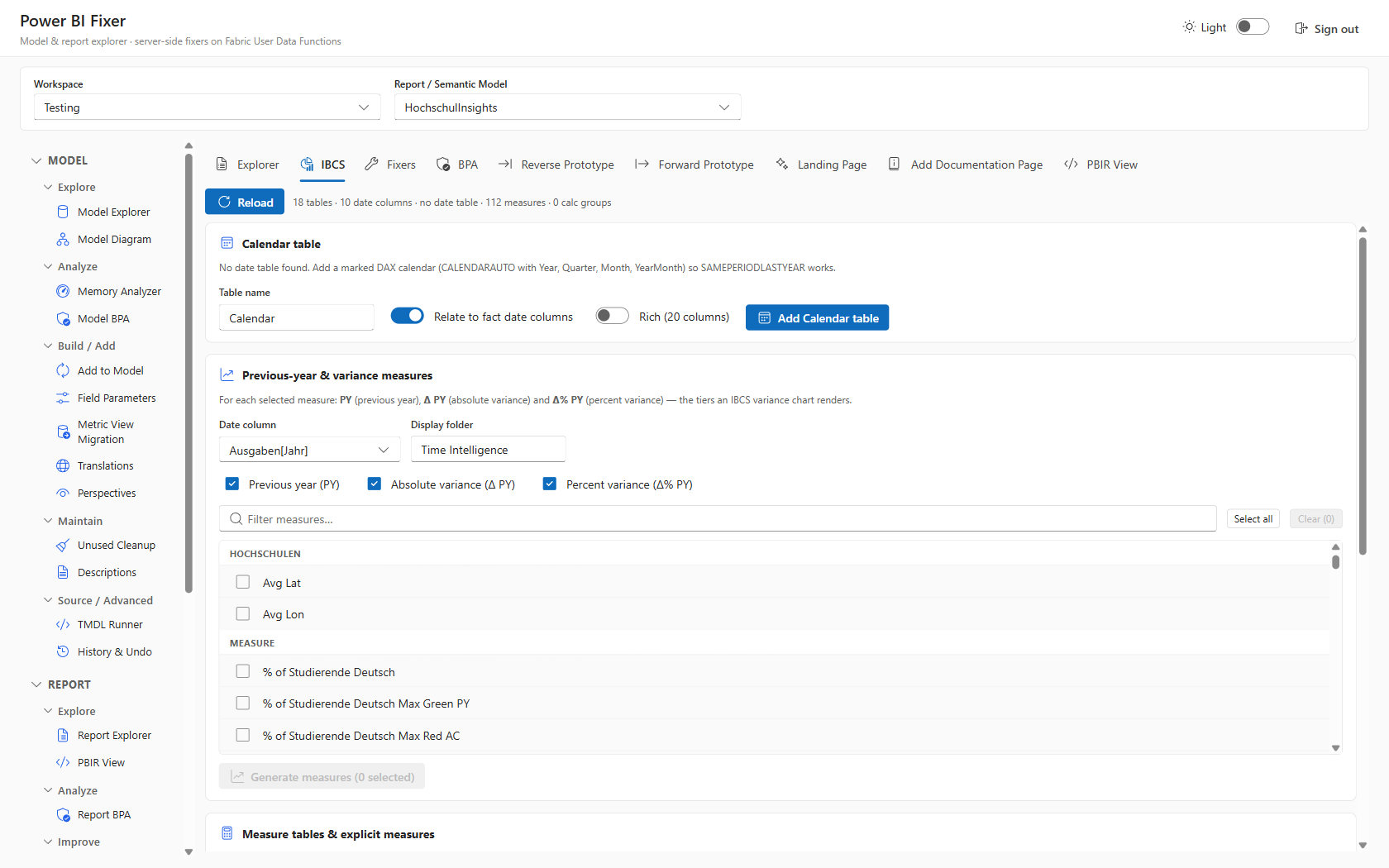
📊 IBCS Variance Builder
Absolute and relative variance measures, done the IBCS way — add a marked calendar table and generate the previous-year and variance measures that power IBCS variance visuals, with a picker for the base measures.
- Marked calendar table
- PY & variance measures
- Base-measure picker
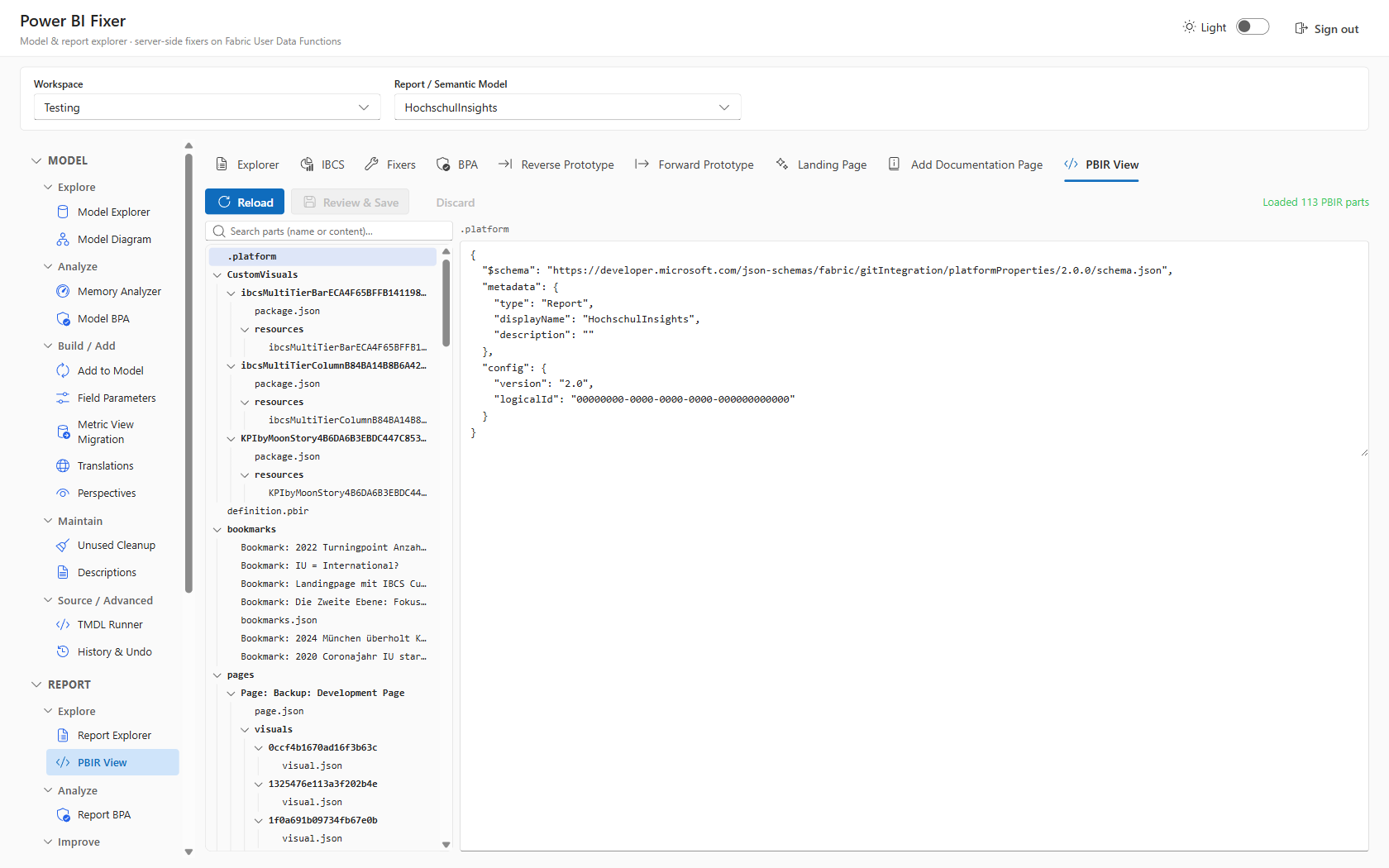
🧾 PBIR View
Inspect the raw enhanced (PBIR) report format — like TMDL view, but for reports — as an editable parts tree with a JSON editor for surgical, low-level changes.
- Editable PBIR parts tree
- Inline JSON editor
- Surgical low-level edits
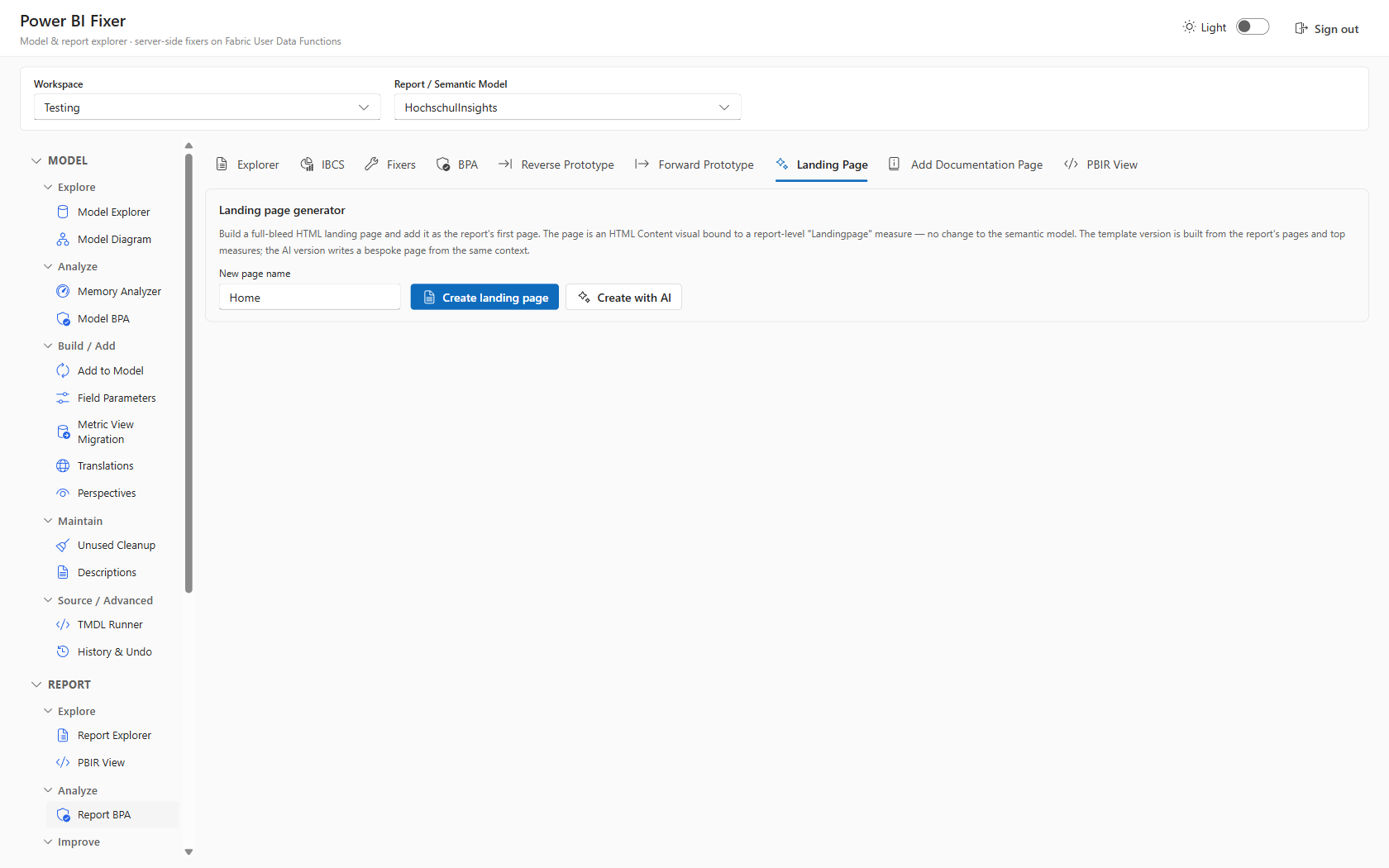
🪧 Landing Page Generator
Generate a polished report landing / navigation page with AI, ready to drop into the report.
- AI-generated landing page
- Navigation-ready layout
- Drop straight into the report
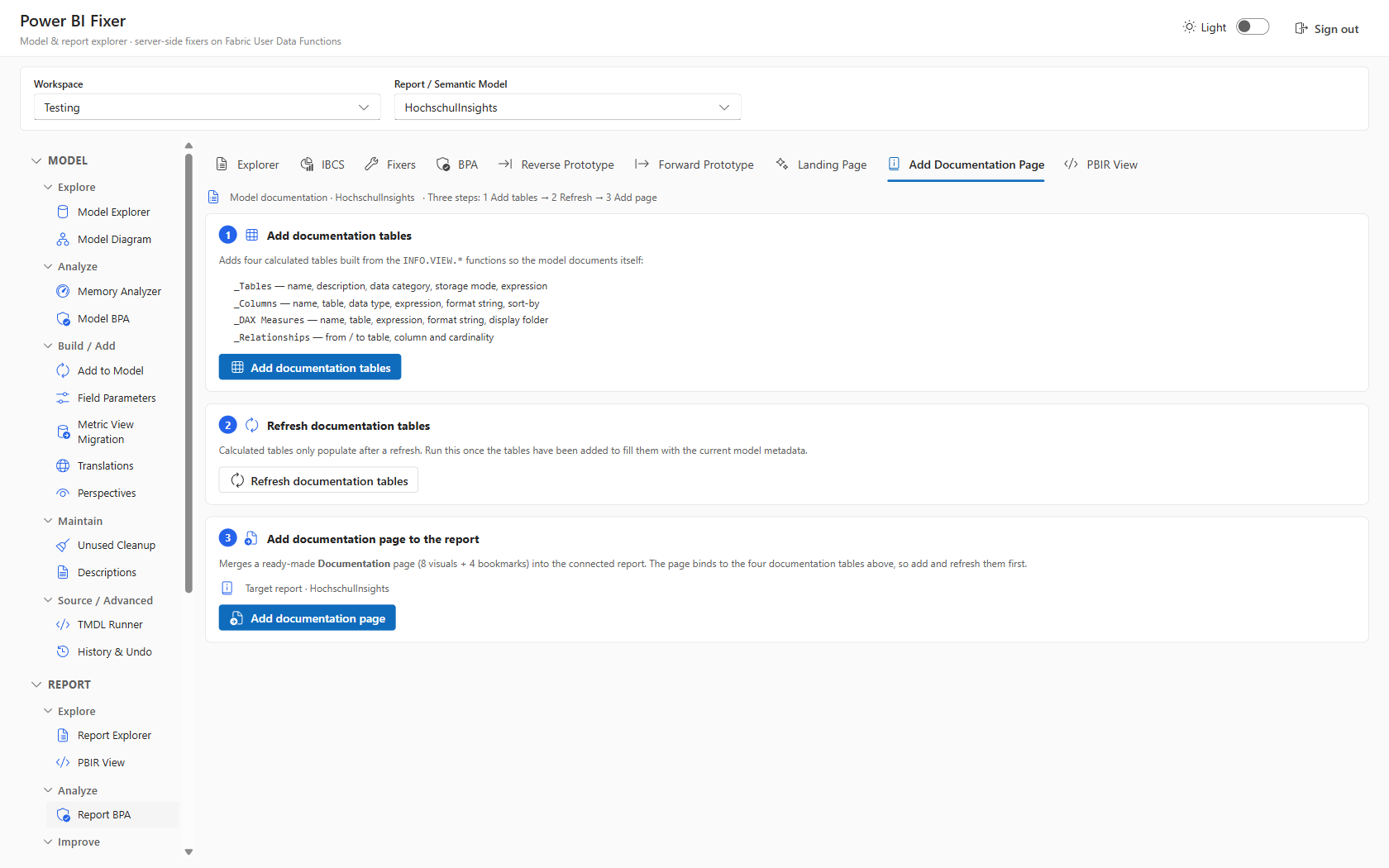
📚 Model Documentation
Auto-generated, share-ready documentation of the whole model — tables, columns, and measures. Original template by Martyn Booth.
- Whole-model documentation page
- Tables, columns & measures
- Guided generation workflow
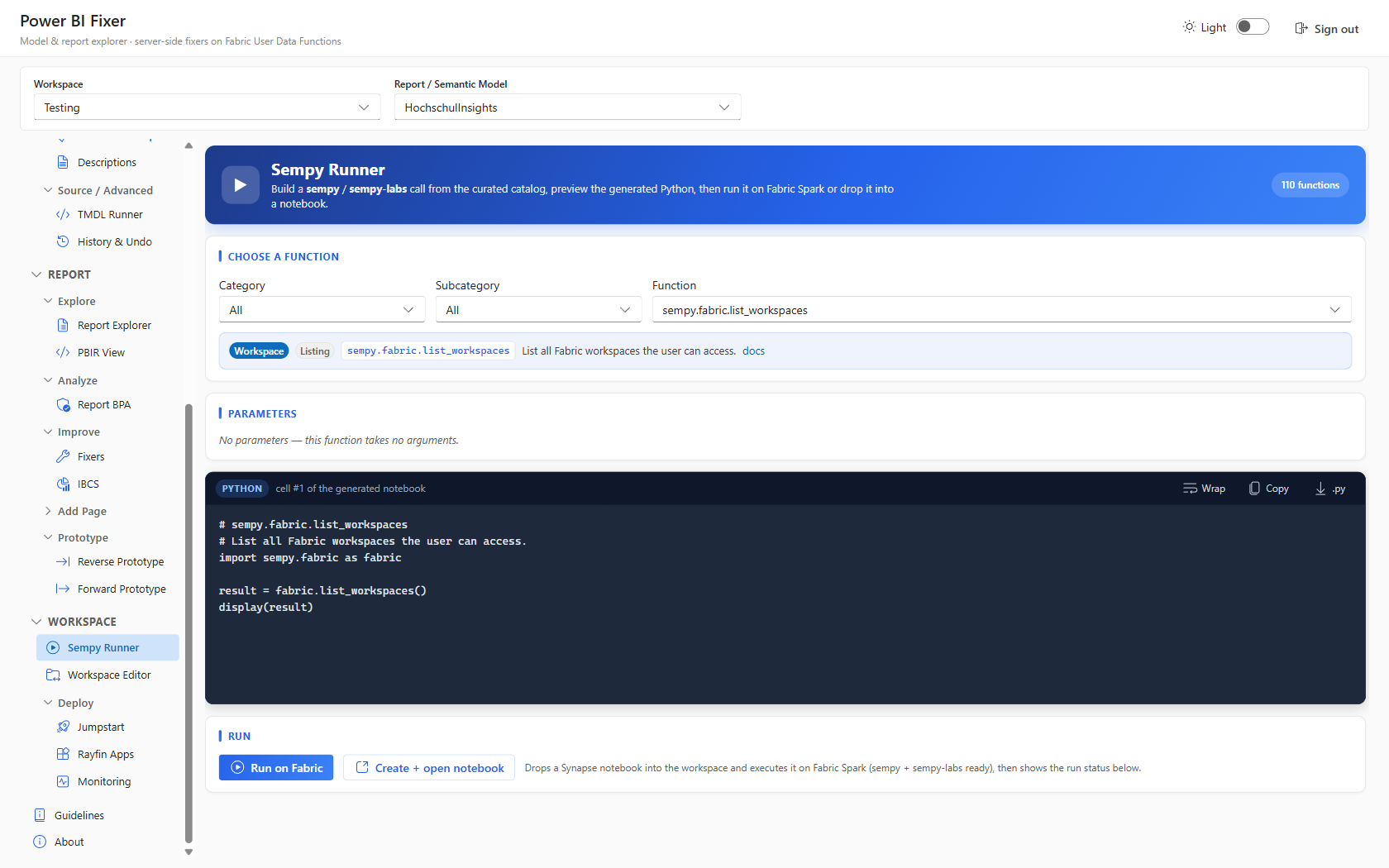
🐍 Sempy Runner
Semantic Link Labs — the hidden champion of Fabric. Build a sempy / sempy-labs call from a curated catalog of 110+ functions, preview the generated Python, then run it on Fabric Spark or drop it into a notebook.
- Catalog of 110+ functions
- Generated-Python preview
- Run on Spark or export to notebook
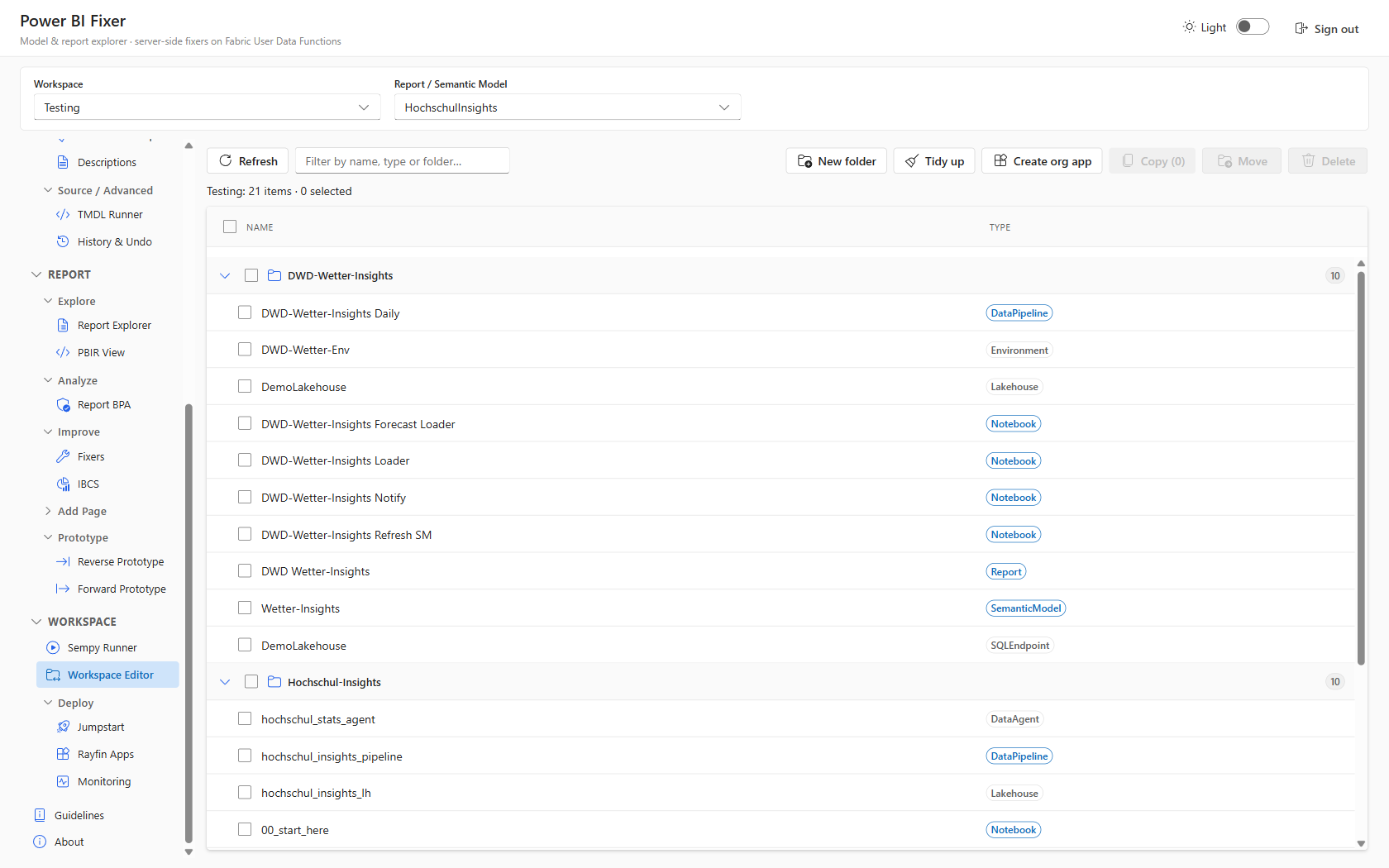
🗂 Workspace Editor
Browse, filter, and organise every item in the workspace, with folder grouping, tidy-up, and one-click org-app creation.
- Browse & filter all items
- Folder grouping & tidy-up
- One-click org-app creation
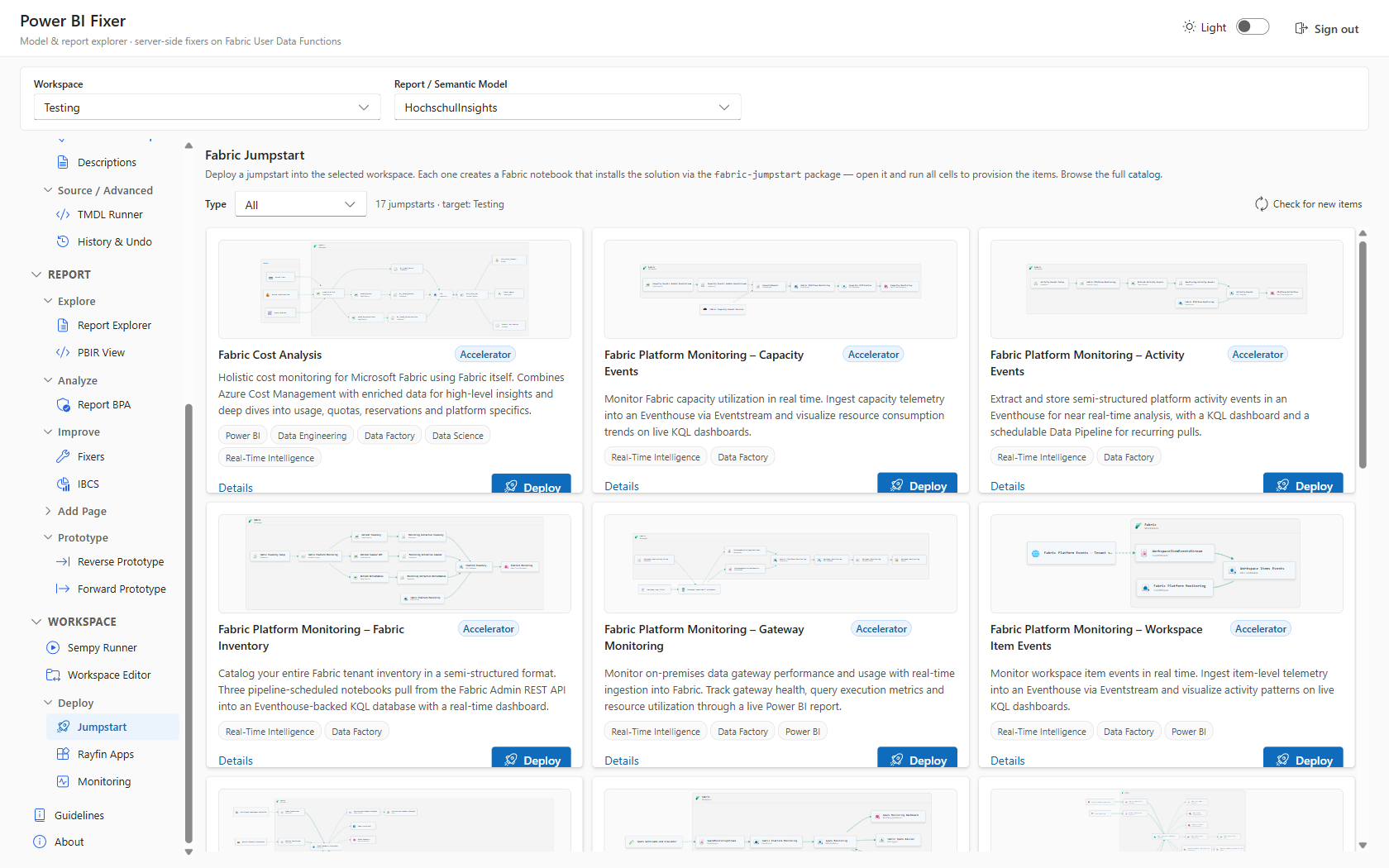
🚀 Fabric Jumpstart
Deploy ready-made Fabric accelerators — cost analysis, platform monitoring, and more — into the workspace as fully provisioned notebooks.
- Ready-made Fabric accelerators
- Cost analysis & monitoring
- Provisioned as notebooks
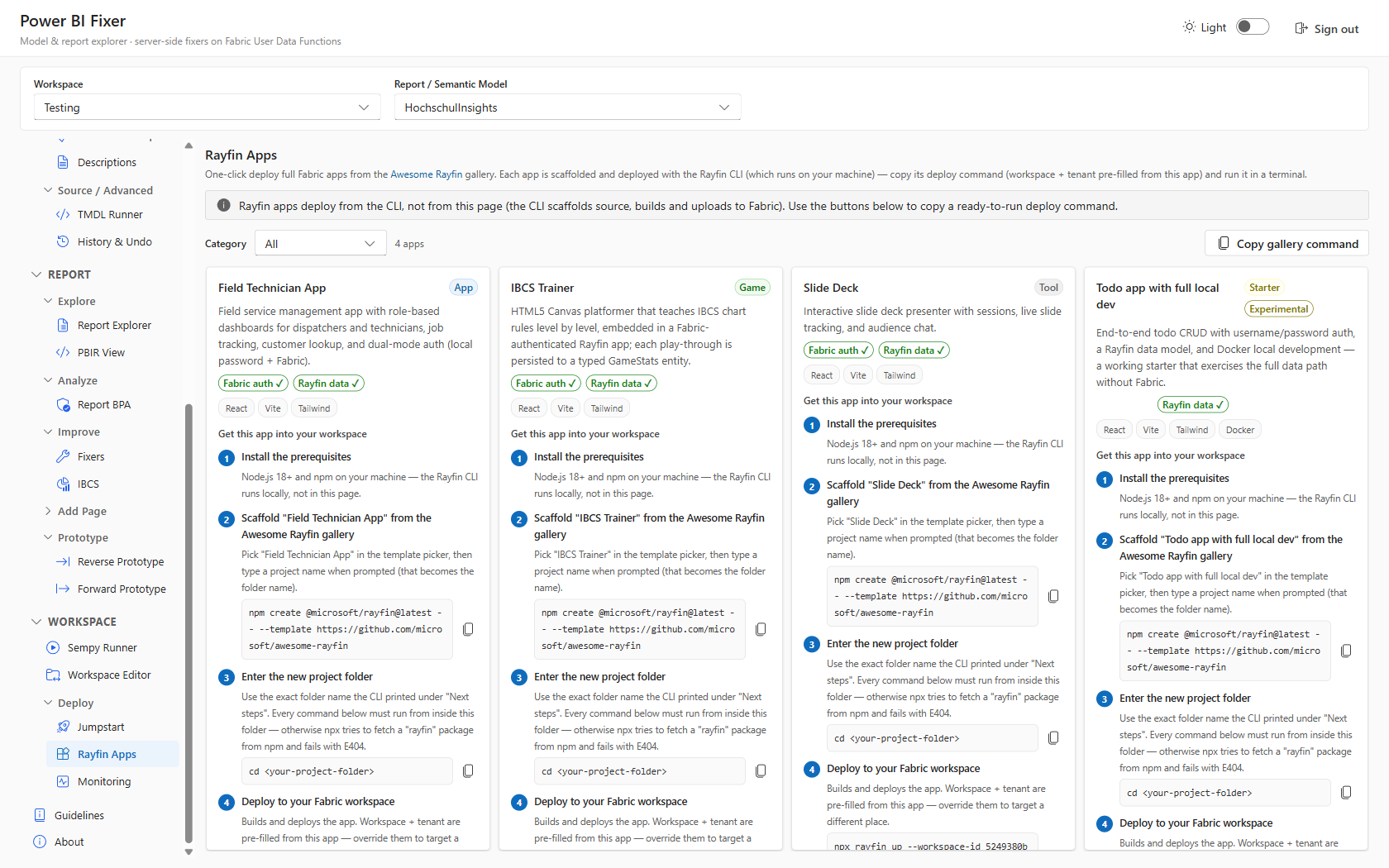
📦 Rayfin Apps
One-click deploy full Fabric apps from the Awesome Rayfin gallery, with a ready-to-run CLI command pre-filled for the selected workspace.
- Awesome Rayfin app gallery
- Pre-filled CLI command
- Deploy to the selected workspace
⭐ Power BI Guidelines
A consolidated best-practice reference spanning data integration, modelling, report design, and maintenance, customisable per team.
- Data integration → maintenance
- Consolidated best practices
- Customisable per team